HSA Contribution Limits 2026: Maximize Health Savings
The 2026 HSA contribution limits offer enhanced opportunities for eligible individuals and families in the US to save for healthcare expenses with significant tax advantages, providing a crucial tool for financial wellness.
By: Rafaela on September 23, 2026
The 2026 HSA contribution limits offer enhanced opportunities for eligible individuals and families in the US to save for healthcare expenses with significant tax advantages, providing a crucial tool for financial wellness.
Are you ready to optimize your healthcare savings for the coming year? Understanding HSA contribution limits 2026 is paramount for anyone looking to leverage this powerful financial tool. Health Savings Accounts (HSAs) offer a unique triple-tax advantage, making them an indispensable part of a robust financial strategy for eligible Americans. As we look towards 2026, staying informed about the latest adjustments can significantly impact your ability to save for future medical expenses while enjoying substantial tax benefits.
Understanding HSA basics and eligibility
Before diving into the specifics of the 2026 contribution limits, it’s essential to grasp what an HSA is and who qualifies. An HSA is a tax-advantaged savings account that can be used for qualified medical expenses. It’s designed to work in conjunction with a High-Deductible Health Plan (HDHP), providing a way for individuals to save and pay for healthcare costs.
Eligibility for an HSA is tied directly to enrollment in an HDHP. These plans typically feature lower monthly premiums but higher deductibles, meaning you pay more out-of-pocket before your insurance coverage kicks in. The IRS sets specific criteria for what constitutes an HDHP each year, including minimum deductibles and maximum out-of-pocket expenses. Meeting these criteria is the first step toward unlocking the benefits of an HSA.
Key eligibility requirements
You must be covered under a high-deductible health plan (HDHP).
You cannot be covered by any other health plan that is not an HDHP (with some exceptions for specific limited-purpose plans).
You cannot be enrolled in Medicare.
You cannot be claimed as a dependent on someone else’s tax return.
Understanding these foundational requirements ensures you are properly positioned to take advantage of HSA benefits. The ability to contribute to an HSA is a valuable opportunity, offering a tax-deductible way to save for healthcare, tax-free growth on investments, and tax-free withdrawals for qualified medical expenses.
The triple tax advantage of HSAs
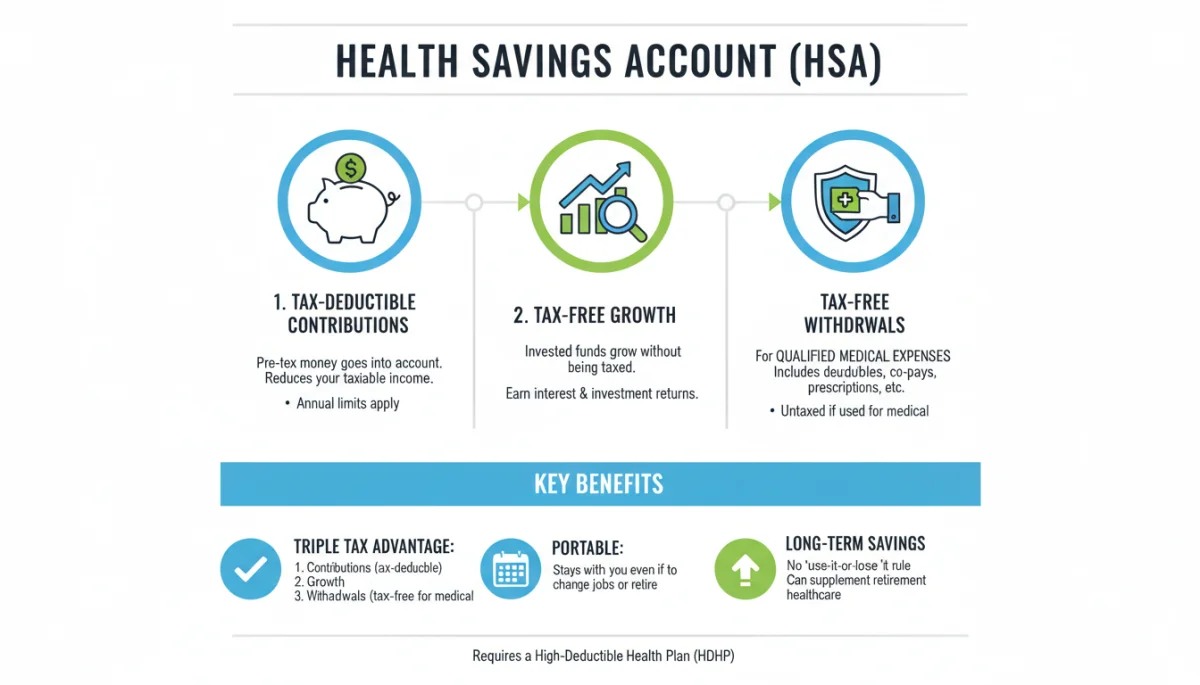
One of the most compelling reasons to utilize an HSA is its unique triple tax advantage. This feature sets HSAs apart from many other savings vehicles and makes them an incredibly effective tool for long-term financial and healthcare planning. For those eligible, maximizing contributions means maximizing these tax benefits.
First, contributions made to an HSA are tax-deductible. This means that the money you put into your HSA reduces your taxable income for the year, potentially lowering your overall tax bill. Whether you contribute directly from your paycheck or make after-tax contributions, you can claim a deduction for these amounts on your tax return. This immediate tax break is a significant incentive for many.
How the triple-tax advantage works
Tax-deductible contributions: Money you put into your HSA reduces your taxable income.
Tax-free growth: Any earnings from investments within your HSA grow tax-free.
Tax-free withdrawals: Funds withdrawn for qualified medical expenses are not taxed.
Second, the money in your HSA grows tax-free. Many HSA providers offer investment options, allowing your balance to grow over time, similar to a 401(k) or IRA. The interest, dividends, and capital gains generated within the account are not subject to taxes, allowing your savings to compound more rapidly. This long-term growth potential is particularly beneficial for those planning for retirement healthcare costs.
Finally, withdrawals from an HSA are tax-free, provided they are used for qualified medical expenses. This includes a wide range of services and products, from doctor visits and prescriptions to dental care and vision expenses. The ability to pay for these costs with tax-free money further enhances the value of the HSA. This triple-tax advantage makes HSAs an incredibly powerful and flexible savings vehicle, especially for those who proactively manage their health and financial future.
Projected HSA contribution limits for 2026
While the official figures for 2026 HSA contribution limits are typically released later in the year, we can project based on historical trends and current inflation rates. The IRS adjusts these limits annually to account for inflation, ensuring the HSA remains a relevant and powerful savings tool. These adjustments are crucial for individuals and families to plan their contributions effectively and maximize their health savings.
For individuals, the limit is expected to see a moderate increase, continuing the trend of gradual adjustments. Similarly, the family contribution limit, which is significantly higher, will also likely rise. These increases are designed to help account holders keep pace with rising healthcare costs and maintain the purchasing power of their savings.
Anticipated 2026 HSA limits (projections)
Self-only coverage: Expected to be approximately $4,300 – $4,350.
Family coverage: Expected to be approximately $8,500 – $8,700.
Catch-up contributions (age 55+): Expected to remain at $1,000.
It’s important to remember that these are projections. The definitive figures will be announced by the IRS, usually in the latter half of the preceding year. However, planning based on these estimates allows for proactive financial adjustments. Beyond the standard contribution limits, individuals aged 55 and older are eligible for an additional catch-up contribution. This extra contribution, which has historically been $1,000, allows older savers to bolster their HSA balances as they approach retirement, addressing the often-higher healthcare costs associated with aging.
Maximizing your HSA contributions
Once you understand the limits, the next step is to strategize how to maximize your HSA contributions. Simply meeting the minimum isn’t enough to fully leverage the power of this account. Proactive planning and consistent contributions are key to building a substantial health savings fund that can cover both immediate and future medical expenses.
One effective strategy is to set up automated contributions. Whether it’s a fixed amount from each paycheck or a monthly transfer from your checking account, automation ensures you consistently contribute without having to remember. This consistent approach helps you reach the annual limit without feeling a significant financial strain all at once. Many employers also offer the option to contribute to your HSA directly through payroll deductions, often with pre-tax advantages.
Strategies for optimal HSA funding
Set up automated contributions to consistently reach annual limits.
Consider making a lump-sum contribution if you receive a bonus or tax refund.
Utilize the catch-up contribution if you are aged 55 or older.
Explore employer contributions, as many companies offer incentives.
Another powerful approach is to contribute the full amount early in the year if your financial situation allows. This permits your money to grow tax-free for a longer period, maximizing the investment potential of your HSA. If a lump-sum contribution isn’t feasible, consider increasing your regular contributions slightly to ensure you hit the maximum by year-end. Remember, HSA funds roll over year after year, so any unused balance continues to grow and remains available for future medical needs. This long-term perspective is vital for truly maximizing your HSA’s potential as a retirement healthcare savings vehicle.
Qualified medical expenses and HSA withdrawals
Understanding what constitutes a qualified medical expense is crucial for leveraging the tax-free withdrawal benefits of your HSA. The IRS provides extensive guidance on eligible expenses, which generally include a broad range of services, treatments, and products necessary for the diagnosis, cure, mitigation, treatment, or prevention of disease, and for the purpose of affecting any structure or function of the body.
This wide scope means HSAs can cover everything from routine doctor visits, prescription medications, and dental care to vision services, mental health counseling, and even certain over-the-counter drugs. It’s important to keep detailed records of your medical expenses, as you may need to prove they were qualified in the event of an IRS audit. Many HSA providers offer tools to help track these expenses, simplifying the process.
Common qualified expenses
Doctor’s office visits and co-pays
Prescription medications and some over-the-counter drugs
Dental care, including cleanings, fillings, and orthodontia
Vision care, including eye exams, glasses, and contact lenses
Therapy and counseling services
One of the most appealing aspects of an HSA is the flexibility it offers. Unlike a Flexible Spending Account (FSA), HSA funds do not have a “use-it-or-lose-it” rule. Your balance rolls over indefinitely, allowing you to accumulate significant savings over time. This makes HSAs an excellent tool for saving for large, unexpected medical expenses or for healthcare costs in retirement, when medical needs often increase. You can even reimburse yourself for past qualified medical expenses years later, provided you kept proper records. This flexibility underscores the HSA’s role as a powerful, long-term financial planning instrument.
HSA vs. other savings vehicles
While HSAs are exceptional for healthcare savings, it’s important to understand how they compare to other common savings vehicles like 401(k)s and IRAs. Each account serves a different primary purpose, but they can often be used in conjunction to create a comprehensive financial strategy. The key differentiator for an HSA is its specific focus on medical expenses and its unparalleled triple-tax advantage.
A 401(k) or IRA is primarily designed for general retirement savings, offering tax deferral on contributions and growth (for traditional accounts) or tax-free withdrawals in retirement (for Roth accounts). While you can withdraw from these accounts for medical expenses, doing so before retirement age often incurs penalties and taxes. HSAs, on the other hand, allow tax-free withdrawals for qualified medical expenses at any age, making them much more flexible for immediate healthcare needs.
Comparing HSA with 401(k) and IRA
HSA: Triple-tax advantage, specifically for medical expenses, rolls over annually.
401(k)/IRA: General retirement savings, tax-deferred growth, penalties for early non-medical withdrawals.
Flexibility: HSA funds can be used for medical expenses at any time without penalty.
For those who can afford to max out their 401(k) or IRA contributions, an HSA often becomes the next logical step in their savings hierarchy. It acts as an additional, highly tax-efficient retirement account, especially after age 65, when HSA funds can be withdrawn for any purpose without penalty (though non-medical withdrawals would be taxed as ordinary income). This versatility, combined with its distinct tax benefits for healthcare, makes the HSA a unique and valuable component of a well-rounded financial plan, complementing rather than replacing other retirement savings vehicles.
Planning for 2026: next steps
As we approach 2026, taking proactive steps to incorporate the new HSA contribution limits into your financial planning is essential. Staying informed and adjusting your strategy now can set you up for significant long-term savings and tax benefits. The financial landscape is always evolving, and adapting your approach ensures you remain on the most advantageous path.
First, review your current health insurance plan to confirm it remains an HDHP that qualifies for HSA contributions. Insurance plans can change, so a quick check with your provider or employer is prudent. If you’re not currently on an HDHP but are considering one, evaluate if the potential HSA benefits outweigh the higher deductible. For many, the tax advantages and long-term savings potential make the HDHP/HSA combination a compelling choice.
Actionable steps for 2026
Verify your HDHP eligibility with your insurance provider.
Adjust your contribution strategy to meet the new 2026 limits.
Review your HSA investment options to maximize growth.
Educate yourself on qualified medical expenses to ensure tax-free withdrawals.
Next, adjust your contribution amounts to reflect the projected 2026 limits. If you contribute through payroll, inform your HR department or benefits administrator. If you make direct contributions, update your automated transfers. Consider setting a calendar reminder for when the official 2026 limits are announced to make any final adjustments. By taking these steps, you ensure you are fully leveraging the opportunities presented by the HSA, securing your financial health and well-being for years to come.
Key Point
Brief Description
2026 HSA Limits
Projected increases for individual and family coverage based on inflation adjustments.
Triple Tax Advantage
Tax-deductible contributions, tax-free growth, and tax-free withdrawals for qualified medical expenses.
Eligibility
Must be enrolled in a High-Deductible Health Plan (HDHP) and meet other IRS criteria.
Maximization Tips
Automate contributions, utilize catch-up contributions, and invest funds for growth.
Frequently asked questions about HSAs
What are the primary benefits of an HSA?▼
The primary benefits of an HSA include a triple tax advantage: contributions are tax-deductible, earnings grow tax-free, and withdrawals for qualified medical expenses are also tax-free. This makes it a powerful tool for health and retirement savings.
How do I qualify for an HSA in 2026?▼
To qualify for an HSA in 2026, you must be covered under a high-deductible health plan (HDHP) that meets IRS criteria, not be enrolled in Medicare, and not be claimed as a dependent on someone else’s tax return.
Can I use my HSA for non-medical expenses?▼
You can use your HSA for non-medical expenses, but if you do so before age 65, the withdrawals will be subject to income tax and a 20% penalty. After age 65, non-medical withdrawals are taxed as ordinary income without penalty.
Do HSA funds expire or have a ‘use-it-or-lose-it’ rule?▼
No, HSA funds do not expire. Unlike Flexible Spending Accounts (FSAs), your HSA balance rolls over from year to year, allowing you to accumulate significant savings over time for future medical expenses, including those in retirement.
When will the official 2026 HSA limits be announced?▼
The IRS typically announces the official HSA contribution limits for the upcoming year in the latter half of the preceding year, usually around May or June. It’s wise to monitor IRS announcements for the definitive figures.
Conclusion
Navigating the landscape of healthcare costs and personal finance requires foresight and strategic planning. Understanding and leveraging the HSA contribution limits 2026 is a critical component of this strategy for eligible Americans. The triple-tax advantage offered by Health Savings Accounts provides an unparalleled opportunity to save for medical expenses, grow your wealth tax-free, and withdraw funds without penalty for qualified healthcare needs. By staying informed, maximizing your contributions, and understanding the nuances of HSA eligibility and qualified expenses, you can significantly enhance your financial well-being and secure a healthier financial future. Proactive engagement with your HSA ensures you are not just saving, but truly optimizing your health savings for years to come.