Optimizing Your Roth IRA Contributions in 2026: Maxing Out the $7,000 Limit
Maximizing your Roth IRA contributions in 2026, up to the $7,000 limit, is a powerful strategy for tax-free growth and withdrawals in retirement, requiring careful planning around income thresholds.
By: Rafaela on September 23, 2026
Maximizing your Roth IRA contributions in 2026, up to the $7,000 limit, is a powerful strategy for tax-free growth and withdrawals in retirement, requiring careful planning around income thresholds.
Are you ready to supercharge your retirement savings? Understanding how to maximize your roth IRA contributions 2026 is crucial for securing a financially comfortable future, especially with the increased contribution limit of $7,000.
Understanding the Roth IRA Advantage for 2026
The Roth IRA stands as a cornerstone of retirement planning for many Americans, offering a unique blend of tax advantages that can significantly benefit your long-term financial health. Unlike traditional IRAs, contributions to a Roth IRA are made with after-tax dollars, meaning your qualified withdrawals in retirement are entirely tax-free. This characteristic makes it particularly appealing for those who anticipate being in a higher tax bracket during their retirement years than they are today.
For 2026, the individual contribution limit for Roth IRAs is set at $7,000, an increase that provides an even greater opportunity for savers to build substantial tax-free wealth. This limit applies to those under age 50; individuals aged 50 and over are typically allowed an additional catch-up contribution, further enhancing their savings potential. Understanding these limits and the tax-free growth potential is the first step toward optimizing your retirement strategy.
The Power of Tax-Free Growth
One of the most compelling benefits of a Roth IRA is the ability for your investments to grow completely tax-free over decades. This means that all the dividends, interest, and capital gains your investments accrue within the Roth IRA account are not subject to federal income tax when you withdraw them in retirement, provided you meet certain conditions. This can translate into hundreds of thousands, or even millions, of dollars in tax savings over your lifetime.
Tax-Free Withdrawals: Qualified distributions in retirement are completely free from federal income tax.
No Required Minimum Distributions (RMDs): Unlike traditional IRAs, Roth IRAs do not have RMDs for the original owner, offering greater flexibility in managing your retirement income.
Estate Planning Benefits: Roth IRAs can be powerful estate planning tools, allowing your beneficiaries to inherit tax-free assets.
The tax-free nature of a Roth IRA also offers predictability. You know that when you access these funds in retirement, their value won’t be eroded by unexpected tax liabilities, providing a clear picture of your future financial resources. This certainty is a significant advantage in an ever-changing tax landscape.
In summary, the Roth IRA’s tax-free growth and withdrawal benefits, coupled with the increased 2026 contribution limit, make it an indispensable tool for proactive retirement savers. Understanding these foundational advantages is key to leveraging the Roth IRA to its fullest potential.
Navigating Income Limits and Phase-Outs in 2026
While the Roth IRA offers incredible benefits, it’s essential to understand that not everyone can contribute directly to one. The Internal Revenue Service (IRS) imposes income limitations that can either restrict or entirely phase out your ability to make direct Roth IRA contributions. These limitations are tied to your Modified Adjusted Gross Income (MAGI) and are adjusted annually for inflation.
For 2026, these MAGI thresholds will be critical for determining your eligibility. If your income exceeds certain levels, your ability to contribute directly to a Roth IRA will begin to phase out, and at higher income levels, you may be completely ineligible for direct contributions. This necessitates careful financial planning and a clear understanding of the IRS guidelines.
Understanding Modified Adjusted Gross Income (MAGI)
Your MAGI is a key figure in determining your Roth IRA eligibility. It’s your adjusted gross income (AGI) with certain deductions added back. For most people, AGI is the primary component, but understanding what specific deductions are added back to calculate MAGI for Roth IRA purposes is vital. These can include deductions for student loan interest, tuition and fees, and certain self-employment taxes, among others.
Income Thresholds: The IRS sets specific MAGI ranges for single filers, married filing jointly, and married filing separately that determine eligibility.
Partial Contributions: If your MAGI falls within the phase-out range, you might be able to make a reduced contribution.
Full Ineligibility: Exceeding the upper MAGI limit means no direct Roth IRA contributions are permitted.
It’s important to consult the official IRS guidelines for 2026 as soon as they are released to confirm the exact MAGI limits. Planning proactively based on estimated income can help you avoid surprises and ensure you utilize all available retirement savings avenues.
The income limitations and phase-out rules are designed to ensure that Roth IRA benefits are targeted. However, for those who exceed these limits, there are still strategies available to access the Roth IRA’s advantages, which we will explore further. Successfully navigating these rules is a critical component of optimizing your roth IRA contributions 2026.
The Backdoor Roth IRA Strategy: A 2026 Essential
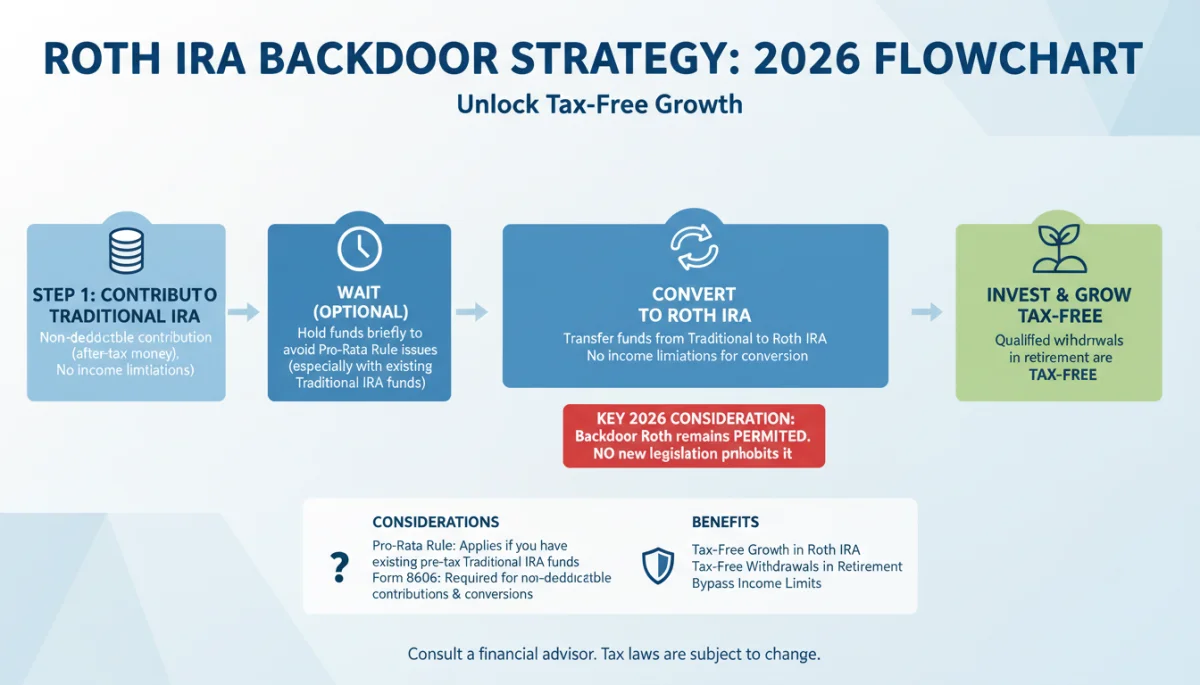
For high-income earners who exceed the IRS’s MAGI limits for direct Roth IRA contributions, the backdoor Roth IRA strategy remains a powerful and entirely legal method to get money into a Roth account. This strategy involves making a non-deductible contribution to a traditional IRA and then converting those funds to a Roth IRA. While it sounds complex, it’s a relatively straightforward process once you understand the steps involved.
The continued viability of the backdoor Roth IRA strategy in 2026 is crucial for many individuals seeking tax-free growth. It allows those who are otherwise locked out of direct contributions to still benefit from the Roth IRA’s advantages, including tax-free withdrawals in retirement and no required minimum distributions for the original owner.
Executing the Backdoor Roth IRA
The core of the backdoor Roth IRA involves two distinct steps. First, you contribute to a traditional IRA, ensuring it’s a non-deductible contribution. This is critical because if you deduct the contribution, you’ll be taxed on the conversion. Second, you convert the traditional IRA funds to a Roth IRA. This conversion is generally tax-free if the original contribution was non-deductible and you have no other pre-tax IRA money.
Non-Deductible Contribution: Fund a traditional IRA with after-tax dollars.
Immediate Conversion: Convert the traditional IRA funds to a Roth IRA shortly after contribution.
Pro-Rata Rule Awareness: Be mindful of the pro-rata rule if you hold other pre-tax IRA accounts, as this can complicate the tax implications of the conversion.
The pro-rata rule is a significant consideration. If you have existing pre-tax traditional IRA, SEP IRA, or SIMPLE IRA accounts, the IRS views all your traditional IRA money (pre-tax and after-tax) as a single pool. When you convert, a portion of the conversion will be considered pre-tax and thus taxable. To avoid this, some individuals consider rolling over pre-tax IRA funds into an employer-sponsored plan, like a 401(k), before executing the backdoor Roth.
Avoiding Common Pitfalls
While the backdoor Roth is a valuable tool, it’s not without its nuances. Incorrect execution can lead to unexpected tax liabilities. It’s advisable to consult with a financial advisor or tax professional to ensure you navigate the process correctly, especially if your financial situation is complex or if you have existing pre-tax IRA balances. Proper record-keeping, particularly IRS Form 8606, is also essential for documenting non-deductible contributions and avoiding double taxation.
In essence, the backdoor Roth IRA strategy provides a vital pathway for high-income earners to make roth IRA contributions 2026. Understanding its mechanics and potential pitfalls is key to successfully leveraging this strategy for your retirement savings.
Strategic Investment Choices Within Your Roth IRA
Once you’ve successfully contributed to your Roth IRA, the next crucial step is to make strategic investment choices within the account. The investment vehicles you choose can significantly impact the growth of your tax-free savings over time. Given the long-term nature of retirement investing, a well-thought-out investment strategy is paramount to maximizing the benefits of your Roth IRA.
The beauty of a Roth IRA is that the tax-free growth applies to virtually any investment held within it, from stocks and bonds to mutual funds and exchange-traded funds (ETFs). This flexibility allows you to tailor your investment strategy to your risk tolerance, time horizon, and financial goals, all while enjoying the tax-free benefits.
Diversification and Asset Allocation
A fundamental principle of sound investing is diversification. Spreading your investments across different asset classes, industries, and geographies helps to mitigate risk and potentially enhance returns. Within your Roth IRA, consider a diversified portfolio that aligns with your personal investment profile. Asset allocation, the process of dividing your investment portfolio among different asset categories, is equally important.
Growth Stocks: Companies with high growth potential, suitable for longer time horizons.
Dividend Stocks: Provide regular income, which grows tax-free within the Roth IRA.
Index Funds/ETFs: Offer broad market exposure and diversification at a low cost.
Bonds: Can provide stability and income, particularly as retirement approaches.
Your asset allocation should evolve as you approach retirement. Younger investors with a longer time horizon typically have a higher allocation to equities, while those closer to retirement might shift towards a more conservative mix with a higher proportion of bonds.
Rebalancing Your Portfolio
Periodically rebalancing your Roth IRA portfolio is essential to maintain your desired asset allocation and risk level. Over time, market fluctuations can cause certain asset classes to outperform others, leading your portfolio to drift from its original target allocation. Rebalancing involves selling some of the outperforming assets and buying more of the underperforming ones to bring your portfolio back into alignment.
For example, if your stock allocation has grown significantly due to a strong market, you might sell some stocks and buy more bonds to restore your target percentages. This disciplined approach helps to lock in gains and manage risk effectively, ensuring your roth IRA contributions 2026 continue to work optimally for you.
In conclusion, the investment choices you make within your Roth IRA are just as important as the act of contributing itself. A well-diversified and regularly rebalanced portfolio, tailored to your individual circumstances, will maximize the tax-free growth potential of your Roth IRA over the long term.
Contribution Strategies for Maxing Out the $7,000 Limit
Successfully maxing out your Roth IRA contributions in 2026 requires more than just knowing the $7,000 limit; it demands a strategic approach to funding. Consistency and planning are key to ensuring you take full advantage of this valuable retirement savings vehicle. Whether you prefer a lump sum contribution or regular payments, having a clear strategy can make all the difference.
Many individuals find it challenging to come up with a lump sum of $7,000 at the beginning of the year. Fortunately, there are several effective strategies to help you reach this goal throughout the year, making the process more manageable and less financially burdensome.
Dollar-Cost Averaging
One of the most popular and effective strategies for maxing out your Roth IRA is dollar-cost averaging. This involves contributing a fixed amount of money at regular intervals (e.g., weekly, bi-weekly, or monthly) regardless of market fluctuations. For the $7,000 limit in 2026, this could mean contributing approximately $583.33 each month.
Reduces Market Timing Risk: By investing regularly, you buy more shares when prices are low and fewer when prices are high, averaging out your purchase cost over time.
Promotes Consistency: Automating contributions ensures you consistently save without needing to actively decide each month.
Budget-Friendly: Spreading contributions throughout the year can be easier on your budget than a single lump sum.
Automating your contributions by setting up recurring transfers from your checking account to your Roth IRA is an excellent way to implement dollar-cost averaging. This “set it and forget it” approach helps ensure you stay on track to reach the $7,000 limit without constant manual effort.
Year-End Lump Sum or Bonus Allocation
Another strategy involves making a lump sum contribution, particularly if you anticipate receiving a significant bonus or tax refund. While dollar-cost averaging is often recommended, a lump sum at the beginning of the year allows your money to be invested for the longest possible time, potentially maximizing growth.
If a year-end bonus is part of your compensation, consider allocating a portion of it directly to your Roth IRA. This can be an efficient way to make a substantial contribution without impacting your regular monthly budget. The key is to plan ahead and earmark these funds specifically for your retirement savings.
Ultimately, the best contribution strategy depends on your personal financial situation and preferences. The goal is always to ensure you reach the $7,000 limit for your roth IRA contributions 2026, leveraging either consistent smaller payments or strategic larger deposits to optimize your retirement savings.
Beneficiary Designations and Estate Planning with Roth IRAs
While the immediate benefits of a Roth IRA often focus on tax-free growth and withdrawals during your lifetime, its role in estate planning is equally significant. Properly designating beneficiaries for your Roth IRA can ensure that your accumulated wealth is passed on efficiently and tax-free to your loved ones, providing a powerful legacy.
The rules surrounding inherited Roth IRAs can be complex, but understanding them in 2026 is crucial for effective estate planning. The Secure Act of 2019 introduced significant changes to inherited IRA rules, particularly for non-spouse beneficiaries, making careful planning even more important.
Designating Primary and Contingent Beneficiaries
When setting up your Roth IRA, you will be asked to designate a primary beneficiary (or beneficiaries) and often a contingent beneficiary. The primary beneficiary is the first in line to receive the assets, while the contingent beneficiary steps in if the primary beneficiary predeceases you. It’s vital to keep these designations up to date, especially after significant life events like marriage, divorce, or the birth of children.
Spousal Beneficiary: A spouse typically has the most flexibility, often able to roll over the inherited Roth IRA into their own or treat it as their own.
Non-Spousal Beneficiary: Subject to the 10-year rule, requiring the inherited Roth IRA to be fully distributed within 10 years of the original owner’s death.
Trust as Beneficiary: Can offer greater control over distributions but often comes with more complex tax implications and administrative burdens.
Failing to name a beneficiary can result in the Roth IRA becoming part of your probate estate, which can lead to delays and additional expenses. Furthermore, the assets might be distributed according to state law, which may not align with your wishes.
The 10-Year Rule for Non-Spousal Beneficiaries
For non-spouse beneficiaries, the Secure Act replaced the “stretch IRA” provision with a 10-year rule. This means that most non-spouse beneficiaries must fully withdraw all assets from the inherited Roth IRA within 10 years following the original owner’s death. While the distributions are still tax-free, this rule requires beneficiaries to plan carefully to manage their tax situation and investment strategy during this period.
Understanding these rules and making informed decisions about your beneficiaries are critical components of your overall financial plan. A well-structured Roth IRA, with appropriate beneficiary designations, ensures that your hard-earned tax-free savings continue to benefit those you intend, solidifying the long-term impact of your roth IRA contributions 2026.
Common Misconceptions and Advanced Roth IRA Strategies
Despite their popularity, Roth IRAs are often surrounded by misconceptions that can prevent individuals from fully utilizing their benefits. Dispelling these myths and understanding advanced strategies can help you optimize your roth IRA contributions 2026 and enhance your retirement planning. It’s not just about contributing; it’s about smart, informed utilization.
One common misconception is that if you’re a high-income earner, a Roth IRA is completely off-limits. As discussed, the backdoor Roth strategy directly refutes this. Another myth is that Roth IRAs are only for young people. While starting early is beneficial, a Roth IRA can be valuable at any age, especially for those who anticipate higher tax rates in retirement.
Myth Busting: Roth IRA vs. 401(k)
Many people view Roth IRAs and Roth 401(k)s as interchangeable, but they have distinct differences. While both offer tax-free withdrawals in retirement, Roth 401(k)s often have higher contribution limits and are employer-sponsored. Understanding which one, or both, best fits your financial situation is key.
Contribution Limits: Roth 401(k)s typically have much higher contribution limits than Roth IRAs.
Employer Match: Employer contributions to a Roth 401(k) are always pre-tax, even if your contributions are Roth.
Withdrawal Flexibility: Roth IRAs offer more flexibility for early withdrawals of contributions without penalty.
It’s often beneficial to contribute to both a Roth 401(k) (especially if there’s an employer match) and a Roth IRA if your income allows. This dual approach maximizes your tax-free retirement savings potential.
The Mega Backdoor Roth Strategy
For those with access to a 401(k) plan that allows after-tax contributions and in-service distributions, the mega backdoor Roth strategy can be a game-changer. This advanced strategy allows you to contribute significantly more than the standard Roth IRA limits by funneling after-tax 401(k) contributions into a Roth IRA or Roth 401(k).
This involves making after-tax contributions to your 401(k) beyond the pre-tax and Roth 401(k) limits, up to the overall 401(k) contribution limit (which is substantially higher than the IRA limit). These after-tax funds are then converted to a Roth IRA or Roth 401(k). This can dramatically boost your tax-free retirement savings, making your roth IRA contributions 2026 strategy even more robust.
Navigating these advanced strategies often requires professional guidance. A financial advisor can help you determine if these options are suitable for your specific financial circumstances and ensure compliance with IRS regulations. By understanding these nuances, you can truly optimize your Roth IRA planning for 2026 and beyond.
Key Aspect
Brief Description
2026 Contribution Limit
The maximum amount you can contribute to a Roth IRA for 2026 is $7,000 (under 50).
Income Phase-Outs
MAGI limits determine eligibility for direct Roth IRA contributions, potentially reducing or eliminating your ability to contribute.
Backdoor Roth Strategy
A method for high-income earners to contribute to a Roth IRA by converting non-deductible traditional IRA funds.
Strategic Investing
Diversifying and rebalancing your Roth IRA portfolio maximizes tax-free growth over the long term.
Frequently Asked Questions About Roth IRA Contributions in 2026
What is the primary benefit of a Roth IRA for 2026?▼
The main advantage of a Roth IRA is that all qualified withdrawals in retirement are completely tax-free. This means you won’t pay federal income tax on your contributions or earnings when you take money out, offering significant long-term tax savings, especially if you expect to be in a higher tax bracket later.
Who is eligible to contribute directly to a Roth IRA in 2026?▼
Eligibility for direct Roth IRA contributions in 2026 depends on your Modified Adjusted Gross Income (MAGI). The IRS sets specific income thresholds; if your MAGI exceeds these limits, your ability to contribute directly will either be reduced or eliminated. Check official IRS guidelines for precise figures.
Can I still contribute to a Roth IRA if my income is too high?▼
Yes, high-income earners can often utilize the “backdoor Roth IRA” strategy. This involves making a non-deductible contribution to a traditional IRA and then converting those funds to a Roth IRA. This allows you to bypass the direct income limitations and still benefit from tax-free growth.
What is the $7,000 limit for Roth IRA contributions in 2026?▼
The $7,000 limit refers to the maximum amount an individual under age 50 can contribute to a Roth IRA in 2026. This limit is subject to annual adjustments for inflation and may be higher for those aged 50 and over due to catch-up contributions.
What happens if I withdraw Roth IRA contributions early?▼
You can withdraw your Roth IRA contributions at any time, for any reason, tax-free and penalty-free. However, withdrawing earnings before age 59½ or before the account has been open for five years (whichever is later) may incur income taxes and a 10% penalty, unless an exception applies.
Conclusion
Optimizing your roth IRA contributions 2026, particularly by maxing out the $7,000 limit, is a cornerstone of effective retirement planning. By understanding the tax-free advantages, navigating income limitations through strategies like the backdoor Roth, and making strategic investment choices, you can build substantial tax-free wealth. Proactive planning, consistent contributions, and informed decision-making are paramount to leveraging the full power of this exceptional retirement vehicle, ensuring a more secure and prosperous financial future.