2026 Social Security COLA: Retirement Planning Solutions in the US
Understanding the 2026 Social Security COLA is crucial for effective retirement income planning in the US, requiring proactive strategies to maximize benefits and ensure financial security.
By: Rafaela on September 23, 2026
Understanding the 2026 Social Security COLA is crucial for effective retirement income planning in the US, requiring proactive strategies to maximize benefits and ensure financial security.
As we look towards the future, understanding The 2026 Social Security COLA: Practical Solutions for Retirement Income Planning in the US becomes an increasingly vital component of securing your financial well-being. This adjustment, designed to help Social Security benefits keep pace with inflation, directly impacts the purchasing power of retirees.
Understanding the Social Security COLA Mechanism
The Cost-of-Living Adjustment (COLA) for Social Security is an annual increase in benefits to offset inflation. It’s a critical aspect of retirement planning, ensuring that the buying power of your Social Security checks doesn’t erode over time. For 2026, the COLA will be determined by economic factors observed in the preceding year, primarily focusing on the Consumer Price Index for Urban Wage Earners and Clerical Workers (CPI-W).
This mechanism is designed to protect retirees from the rising costs of everyday essentials, from groceries to healthcare. While the exact percentage for 2026 is still speculative, historical trends and current economic indicators provide valuable insights into what beneficiaries might expect. Understanding how this calculation works can empower you to make more informed decisions about your retirement finances.
How COLA is Calculated
The Social Security Administration (SSA) bases the COLA on the increase in the CPI-W from the third quarter of the previous year to the third quarter of the current year. If there’s an increase, the COLA is applied starting in December and reflected in payments issued the following January. This method links benefits directly to inflation, aiming to preserve your financial stability.
CPI-W Index: The primary economic indicator used for COLA calculations.
Measurement Period: Third quarter data (July, August, September) is crucial.
No Increase Scenario: If there is no increase in CPI-W, there is no COLA.
Impact on Benefits: Directly translates to higher monthly Social Security payments.
Historical COLA Trends and Projections
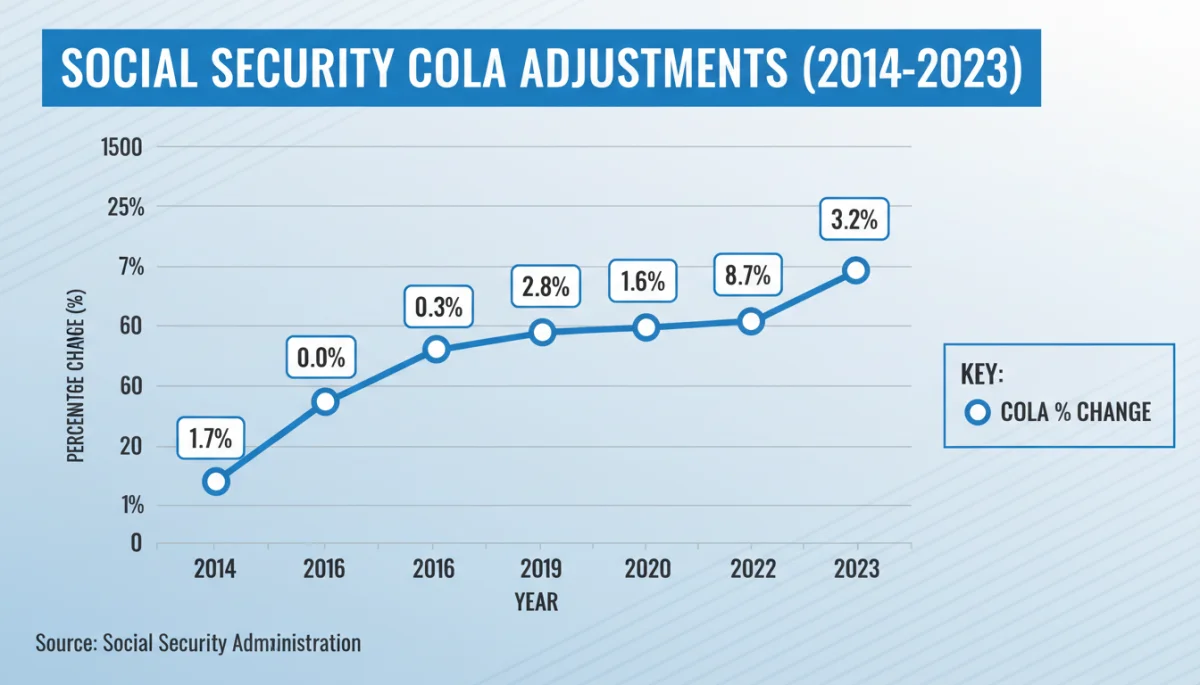
Analyzing past COLA adjustments can offer a glimpse into potential future outcomes. Recent years have seen varying COLA percentages, reflecting different economic climates. While projections for 2026 are still preliminary, economists and financial analysts are already monitoring inflation trends closely to forecast the likely adjustment. These forecasts, though not definitive, are essential for retirees to begin strategizing their financial plans.
The importance of the COLA cannot be overstated for individuals whose Social Security benefits constitute a significant portion of their retirement income. A robust COLA can provide much-needed relief against inflationary pressures, while a smaller adjustment might necessitate a re-evaluation of spending habits and other income sources.
In conclusion, the COLA mechanism is a cornerstone of Social Security’s promise to provide a safety net for retirees. By understanding its calculation and potential future trends, beneficiaries can better prepare for the financial landscape of 2026 and beyond.
Assessing the Impact of 2026 Social Security COLA on Retirement Income
The forthcoming 2026 Social Security COLA will undoubtedly play a significant role in the financial lives of millions of American retirees. Its impact extends beyond just the monthly payment amount, influencing overall budget planning, healthcare costs, and even tax liabilities. A higher COLA can offer a welcome boost to purchasing power, especially in an inflationary environment, while a modest increase might require retirees to seek alternative income strategies.
Understanding these broader implications is crucial for effective retirement income planning. Retirees need to consider how the COLA interacts with other income sources, such as pensions, 401(k) withdrawals, and investment returns, to paint a complete picture of their financial standing.
Budgeting and Spending Adjustments
A COLA increase, however small, directly affects your disposable income. It’s an opportune moment to review your monthly budget and adjust spending habits. For many, Social Security benefits cover essential expenses, so any increase can alleviate pressure on fixed incomes. Conversely, if the COLA is lower than anticipated, it might necessitate tightening the belt or exploring ways to reduce expenditures.
Re-evaluate Monthly Expenses: Compare current spending to your income, including the new COLA.
Prioritize Needs: Ensure essential costs like housing, food, and healthcare are covered.
Adjust Discretionary Spending: If needed, reduce non-essential expenses like entertainment or dining out.
Healthcare Costs and Medicare Premiums
One of the most significant factors influencing retirees’ budgets is healthcare. Medicare Part B premiums, for instance, are often deducted directly from Social Security benefits. A phenomenon known as the ‘hold harmless’ provision typically prevents these premiums from rising more than a retiree’s COLA increase. However, this provision doesn’t apply to all beneficiaries, and rising healthcare costs can still erode the benefits of a COLA.
For 2026, it’s essential to monitor not only the COLA but also projected Medicare premium adjustments. These two figures together will determine the net change in your Social Security check. Planning for potential increases in out-of-pocket medical expenses, even with a COLA, is a prudent strategy for long-term financial health.
The 2026 Social Security COLA is more than just a number; it’s a dynamic factor that influences various aspects of retirement life. By proactively assessing its potential impact on your budget, healthcare, and overall financial strategy, you can better prepare for the year ahead and ensure a more secure retirement.
Strategic Financial Planning for 2026 and Beyond
Effective financial planning for 2026, particularly concerning the Social Security COLA, requires a multifaceted approach. It’s not just about anticipating the COLA percentage, but also about integrating that expectation into a broader financial strategy that encompasses savings, investments, and other income streams. The goal is to build a resilient retirement plan that can withstand economic fluctuations and ensure long-term financial security.
Proactive planning allows retirees to adapt to changes, rather than merely reacting to them. This involves reviewing your current financial situation, setting realistic goals, and exploring various avenues to optimize your retirement income.
Diversifying Income Sources
Relying solely on Social Security benefits can be risky, especially if COLA adjustments are modest. Diversifying your income sources is a cornerstone of robust retirement planning. This could include drawing from a mix of traditional IRAs, Roth IRAs, 401(k)s, annuities, and even part-time work.
Retirement Accounts: Strategically withdraw from 401(k)s and IRAs to manage tax implications.
Annuities: Consider annuities for guaranteed income streams.
Part-time Work: Explore flexible part-time employment for supplemental income and engagement.
Investment Income: Generate passive income from dividends, interest, or rental properties.
Optimizing Investment Portfolios
Your investment portfolio should be aligned with your retirement goals and risk tolerance. As you approach and enter retirement, a shift towards more conservative investments might be appropriate to preserve capital. However, some exposure to growth-oriented assets can still be beneficial to combat inflation over the long term.
Regularly review your asset allocation and make adjustments as needed. Consider consulting with a financial advisor to ensure your portfolio is optimized to generate income and growth while managing risk effectively. The COLA’s potential impact on inflation should be a key consideration in these discussions.
In essence, strategic financial planning for 2026 means taking a holistic view of your financial landscape. By diversifying income, optimizing investments, and planning for potential changes, retirees can build a more secure and adaptable financial future.
Maximizing Social Security Benefits Beyond COLA
While the annual COLA is an important factor, there are several other strategies retirees can employ to maximize their Social Security benefits. These strategies often involve decisions made long before retirement, emphasizing the importance of early planning. Understanding how your claiming age, work history, and spousal benefits interact can significantly increase your lifetime benefits.
The goal is to not just accept the COLA, but to actively work towards receiving the highest possible benefit amount based on your individual circumstances. This proactive approach can lead to a more comfortable and financially secure retirement.
Choosing the Optimal Claiming Age
The age at which you claim Social Security benefits has a profound impact on your monthly payment. While you can claim as early as age 62, your benefits are permanently reduced. Conversely, delaying your claim past your full retirement age (FRA) up to age 70 can result in substantially higher monthly payments due to delayed retirement credits.
The decision of when to claim is highly personal and depends on various factors, including your health, other income sources, and life expectancy. For many, delaying benefits can be one of the most effective ways to maximize their Social Security income, often outweighing the effects of annual COLA adjustments over time.
Understanding Spousal and Survivor Benefits
If you are married, divorced, or widowed, you may be eligible for spousal or survivor benefits, which can significantly enhance your overall Social Security income. Spousal benefits can be up to 50% of your spouse’s full retirement age benefit, while survivor benefits can be even higher.
Spousal Benefits: Claim up to 50% of your spouse’s PIA (Primary Insurance Amount).
Survivor Benefits: Widows or widowers may receive up to 100% of their deceased spouse’s benefit.
Divorced Spouses: May be eligible for benefits based on an ex-spouse’s record under certain conditions.
Coordination Strategies: Strategic claiming between spouses can optimize combined benefits.
Working While Receiving Benefits
For some retirees, continuing to work part-time while receiving Social Security benefits is a viable option. However, if you are below your full retirement age, your benefits may be reduced if your earnings exceed certain limits. Once you reach your full retirement age, these earnings limits no longer apply, and you can earn as much as you like without a reduction in benefits.
Maximizing your Social Security benefits requires careful consideration of various factors beyond just the COLA. By making informed decisions about your claiming age, exploring spousal and survivor options, and understanding the rules around working while receiving benefits, you can significantly enhance your financial security in retirement.
Healthcare and Long-Term Care Planning in Retirement
Healthcare costs are a significant concern for retirees, often consuming a substantial portion of their income. Effective planning for healthcare and potential long-term care needs is paramount to a secure retirement. The 2026 Social Security COLA, while helpful, may not fully cover the rising expenses associated with medical care, making proactive strategies essential.
Ignoring healthcare planning can quickly derail even the most meticulously crafted retirement budget. It’s about understanding your options, anticipating future needs, and setting aside funds specifically for these inevitable expenses.
Navigating Medicare and Supplemental Insurance
Medicare is the primary health insurance for most Americans aged 65 and older. However, Medicare does not cover all medical expenses, and understanding its different parts (A, B, C, D) is crucial. Many retirees opt for supplemental insurance, such as Medigap plans or Medicare Advantage (Part C) plans, to cover gaps in original Medicare coverage.
Choosing the right plan involves assessing your health needs, financial situation, and preferred providers. The costs associated with these plans, including premiums, deductibles, and co-pays, must be factored into your retirement budget alongside your Social Security benefits.
Planning for Long-Term Care
Long-term care, which includes services like in-home care, assisted living, or nursing home care, is a major financial risk for many retirees. Medicare generally does not cover long-term care, making it essential to have a separate plan. Options for funding long-term care include:
Long-Term Care Insurance: Provides coverage for a range of services, but premiums can be substantial.
Hybrid Life Insurance Policies: Combine life insurance with a long-term care rider.
Personal Savings: Designate a portion of your savings specifically for potential long-term care needs.
Medicaid: A safety net for those who exhaust their financial resources, but comes with strict eligibility requirements.
Proactive planning for healthcare and long-term care is an indispensable part of retirement income planning. By understanding Medicare options and exploring strategies for long-term care, retirees can protect their assets and ensure access to necessary medical services without undue financial strain.
Tax Implications of Social Security and Retirement Income
Understanding the tax implications of your Social Security benefits and other retirement income is crucial for effective financial planning. While Social Security benefits are not always taxed, a portion can become taxable if your combined income exceeds certain thresholds. The 2026 Social Security COLA, by increasing your benefit amount, could potentially push more of your Social Security income into the taxable bracket.
This necessitates careful tax planning to ensure you’re not inadvertently losing a significant portion of your retirement income to taxes. The goal is to minimize your tax burden legally and strategically, preserving as much of your hard-earned money as possible.
When Social Security Benefits Become Taxable
The taxability of Social Security benefits depends on your ‘combined income,’ which includes your adjusted gross income (AGI), tax-exempt interest, and half of your Social Security benefits. For 2026, these thresholds are expected to remain similar to current levels, where:
Up to 50% of your benefits may be taxable if your combined income is between $25,000 and $34,000 for individuals, or $32,000 and $44,000 for married couples filing jointly.
Up to 85% of your benefits may be taxable if your combined income is above $34,000 for individuals, or $44,000 for married couples filing jointly.
It’s important to factor in any potential COLA increase when estimating your combined income to avoid surprises at tax time.
Strategies for Tax-Efficient Withdrawals
Beyond Social Security, the way you withdraw money from your various retirement accounts can significantly impact your tax liability. A diversified approach to retirement savings, including pre-tax accounts (like traditional 401(k)s and IRAs) and post-tax accounts (like Roth IRAs), offers flexibility in managing your taxable income.
Consider a ‘tax diversification’ strategy, where you strategically draw from different account types to keep your taxable income below certain thresholds. This could involve:
Roth Conversions: Converting traditional IRA funds to Roth in lower-income years.
Strategic Withdrawals: Balancing withdrawals from taxable, tax-deferred, and tax-free accounts.
Qualified Charitable Distributions (QCDs): For those aged 70½ or older, QCDs from IRAs can reduce taxable income.
Navigating the tax landscape of retirement income is a complex but essential task. By understanding when Social Security benefits become taxable and employing tax-efficient withdrawal strategies, retirees can protect their financial resources and enhance their overall retirement security.
Seeking Professional Financial Guidance
Retirement planning, especially when considering variables like the 2026 Social Security COLA, can be intricate and overwhelming. While self-education is valuable, the expertise of a qualified financial advisor can provide tailored strategies and peace of mind. A professional can help you navigate complex regulations, optimize your income streams, and adapt your plan to changing economic conditions.
Their guidance can be particularly beneficial in making decisions that have long-term implications, such as claiming age for Social Security, investment allocation, and tax planning. They offer an objective perspective and can help you identify potential pitfalls you might overlook.
Benefits of Working with a Financial Advisor
A financial advisor can offer a range of services, from comprehensive financial planning to specific advice on investment management or retirement income strategies. They can help you create a personalized plan that aligns with your financial goals, risk tolerance, and lifestyle aspirations. Their expertise in areas like Social Security optimization, tax planning, and estate planning can be invaluable.
Personalized Planning: Tailored strategies based on your unique financial situation.
Expert Knowledge: Up-to-date information on regulations, market trends, and tax laws.
Objective Perspective: Helps you make rational decisions, free from emotional biases.
Long-Term Vision: Assists in creating a sustainable financial plan for your entire retirement.
Choosing the Right Advisor
Selecting a financial advisor is a crucial decision. Look for advisors who are fiduciaries, meaning they are legally obligated to act in your best interest. Consider their credentials (e.g., Certified Financial Planner™), experience, and fee structure. A good advisor will be transparent about their services and costs, and communicate clearly about your financial situation.
Interview several advisors to find one whose approach and personality resonate with you. A strong working relationship with your advisor can be one of the most valuable assets in your retirement planning journey, providing ongoing support and adjustments as your needs evolve.
In conclusion, while the information provided offers a solid foundation for understanding the 2026 Social Security COLA and retirement planning, seeking professional financial guidance can elevate your strategy. An advisor can help you integrate all aspects of your financial life, ensuring a comprehensive and robust plan for a secure retirement.
Key Point
Brief Description
COLA Mechanism
Annual adjustment to Social Security benefits based on CPI-W to combat inflation.
Income Diversification
Reduce reliance on Social Security by utilizing 401(k)s, IRAs, annuities, and investments.
Claiming Age Optimization
Delaying Social Security claims up to age 70 can significantly increase monthly benefits.
Healthcare Planning
Crucial for budgeting Medicare premiums, supplemental insurance, and long-term care costs.
Frequently Asked Questions About 2026 Social Security COLA
What is the Social Security COLA and how is it determined?▼
The Social Security Cost-of-Living Adjustment (COLA) is an annual increase in benefits designed to combat inflation. It’s calculated based on the Consumer Price Index for Urban Wage Earners and Clerical Workers (CPI-W) from the third quarter of the previous year to the third quarter of the current year.
How will the 2026 COLA affect my Medicare Part B premiums?▼
The ‘hold harmless’ provision generally prevents Medicare Part B premiums from rising more than your COLA increase. However, this doesn’t apply to everyone, and rising healthcare costs can still impact your net benefits. It’s important to monitor both COLA and Medicare premium adjustments.
Are Social Security benefits taxable, especially with a COLA increase?▼
Yes, a portion of your Social Security benefits can be taxable if your ‘combined income’ (AGI + tax-exempt interest + half of benefits) exceeds certain thresholds. A COLA increase could potentially push more of your benefits into the taxable bracket, necessitating careful tax planning.
What are some ways to maximize my Social Security benefits beyond COLA?▼
You can maximize benefits by choosing the optimal claiming age (delaying up to age 70 for higher payments), exploring spousal or survivor benefits, and understanding the rules for working while receiving benefits. These strategies can significantly increase your lifetime Social Security income.
Why is professional financial guidance important for retirement planning?▼
Professional financial advisors offer tailored strategies, expert knowledge on regulations and market trends, and an objective perspective. They can help you navigate complex decisions regarding Social Security, investments, tax planning, and long-term care, ensuring a comprehensive and robust retirement plan.
Conclusion
Navigating the complexities of retirement income planning, particularly with the anticipated 2026 Social Security COLA, demands a proactive and informed approach. From understanding the nuances of COLA calculations and their direct impact on your budget and healthcare costs, to strategically diversifying your income sources and optimizing your Social Security claiming age, every decision plays a crucial role in securing your financial future. Furthermore, diligent planning for healthcare and long-term care, alongside a keen awareness of tax implications, ensures a comprehensive strategy. While this article provides a robust framework, the value of personalized financial guidance cannot be overstated. By embracing these practical solutions and perhaps enlisting the expertise of a financial advisor, retirees can confidently face 2026 and beyond, ensuring their golden years are marked by financial stability and peace of mind.