S&P 500 in 2026: Sector Performance & US Investor Projections

The S&P 500 in 2026 is anticipated to be shaped by evolving sector dynamics, driven by technological advancements, demographic shifts, and shifting economic policies, offering varied opportunities for US investors.
Understanding the S&P 500 in 2026: A Deep Dive into Sector Performance and Future Projections for US Investors is crucial for making informed investment decisions. This article explores the evolving landscape of the S&P 500, offering insights into key sectors and what American investors can anticipate in the coming years. We aim to provide a clear perspective on potential growth areas and challenges.
The Evolving Landscape of the S&P 500
The S&P 500, a bellwether for the US economy, is constantly shifting. As we look towards 2026, several macroeconomic forces are at play, influencing everything from corporate earnings to investor sentiment. Understanding these broader trends is the first step in deciphering future sector performance.
Global economic growth, inflation, interest rates, and geopolitical stability will collectively set the stage for how various industries within the S&P 500 perform. Technological innovation continues to be a dominant theme, but regulatory changes and consumer behavior also exert significant influence. Investors must consider a holistic view rather than focusing on isolated data points.
Key Macroeconomic Drivers for 2026
- Interest Rate Trajectory: The Federal Reserve’s policy decisions will heavily impact borrowing costs and capital allocation across sectors.
- Inflationary Pressures: Persistent or easing inflation will influence consumer spending power and corporate profit margins.
- Global Supply Chains: Continued re-shoring or diversification efforts will affect manufacturing and logistics.
- Technological Disruption: AI, quantum computing, and biotechnology will reshape industries and create new market leaders.
Ultimately, the S&P 500’s trajectory in 2026 will be a complex interplay of these factors. Investors who stay attuned to these overarching themes will be better positioned to adapt their portfolios. The market is dynamic, and a proactive approach is always beneficial.
Technology Sector: Continued Innovation and Growth
The technology sector has been a dominant force in the S&P 500 for decades, and its influence is expected to continue growing into 2026. This sector encompasses a wide array of industries, from software and semiconductors to internet services and hardware. Innovation remains its core driver, constantly creating new markets and disrupting old ones.
Looking ahead, artificial intelligence (AI) and machine learning are poised to be transformative technologies, impacting nearly every other sector. Cloud computing will also continue its expansion, becoming an even more integral part of business operations globally. Cybersecurity, driven by increasing digital threats, will see sustained demand and investment.
Emerging Technologies to Watch
- Advanced AI Applications: Beyond basic automation, expect AI to drive innovation in healthcare diagnostics, personalized education, and complex data analysis.
- Quantum Computing: While still nascent, breakthroughs in quantum computing could revolutionize encryption, drug discovery, and financial modeling.
- Edge Computing: Processing data closer to its source will enhance speed and efficiency for IoT devices and real-time applications.
However, the sector is not without its challenges. Regulatory scrutiny, particularly concerning data privacy and monopolistic practices, could intensify. Geopolitical tensions affecting global supply chains for components like semiconductors also pose risks. Despite these hurdles, the fundamental drive for technological advancement suggests a robust outlook for the sector, albeit with potential volatility.
Healthcare Sector: Demographic Shifts and Biotech Advances
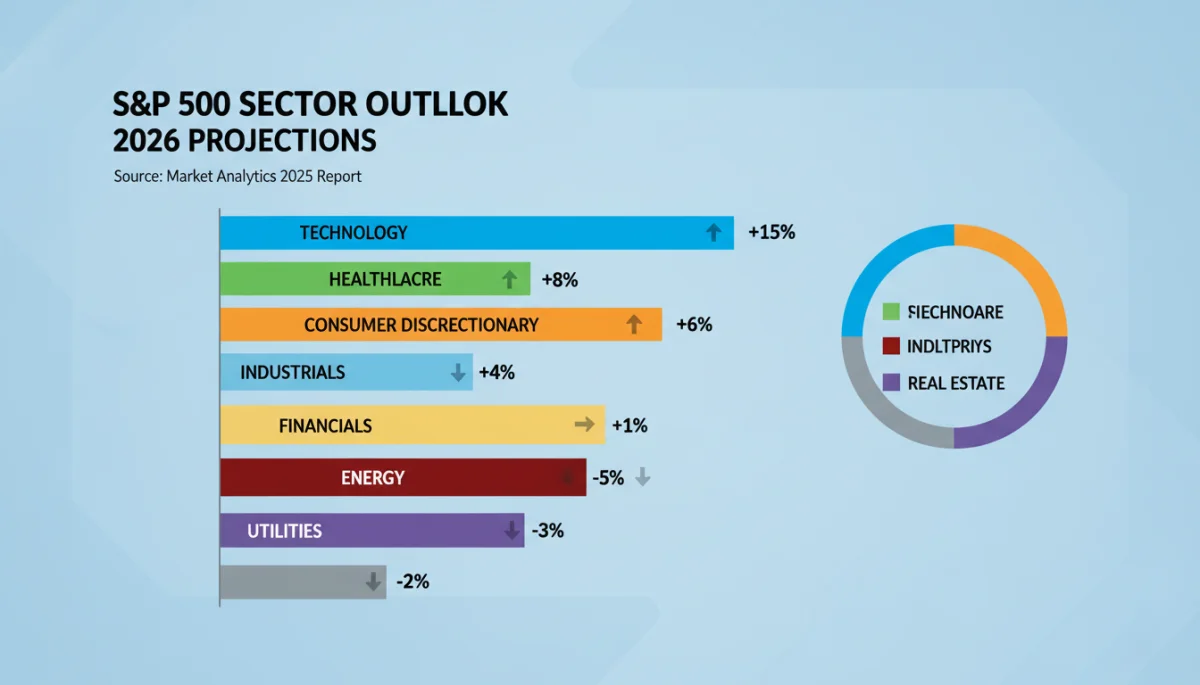
The healthcare sector in the S&P 500 is fundamentally driven by long-term demographic trends and relentless scientific innovation. As the global population ages, particularly in developed economies like the US, demand for healthcare services, pharmaceuticals, and medical devices will inevitably rise. This creates a strong underlying demand curve for the sector.
Biotechnology and personalized medicine are expected to be significant growth engines. Advances in gene editing, targeted therapies, and precision diagnostics promise to revolutionize treatment paradigms for a wide range of diseases. Digital health, including telemedicine and wearable health tech, will also continue its integration into everyday care, enhancing accessibility and efficiency.
Key Drivers in Healthcare
- Aging Population: Increased demand for geriatric care, chronic disease management, and specialized medical treatments.
- Biopharmaceutical Innovation: Development of new drugs and therapies for previously untreatable conditions, driven by R&D investment.
- Healthcare Digitization: Expansion of telemedicine, AI-powered diagnostics, and electronic health records for improved patient outcomes and operational efficiency.
Despite its defensive characteristics, the healthcare sector faces challenges such as rising healthcare costs, regulatory hurdles for new drug approvals, and political pressures regarding drug pricing. Companies that can innovate effectively while navigating these complexities are likely to thrive. Investors should look for firms with strong R&D pipelines and efficient cost structures.
Financials and Industrials: Adapting to Economic Shifts
The Financials and Industrials sectors within the S&P 500 are often seen as barometers of the broader economic health. For 2026, their performance will largely hinge on global economic growth, interest rate environments, and capital expenditure trends. Financials, including banks, insurance companies, and investment firms, benefit from higher interest rates, which can widen their net interest margins.
However, prolonged economic slowdowns or increased regulatory burdens could temper their growth. The shift towards digital banking and fintech solutions will also continue to reshape the competitive landscape, requiring traditional institutions to adapt rapidly. Cybersecurity in financial services remains a paramount concern, driving significant investment.
The Industrials sector, comprising manufacturing, aerospace & defense, transportation, and construction, is highly cyclical. Its performance is tied to corporate capital spending, government infrastructure projects, and global trade volumes. Increased focus on automation, sustainable manufacturing practices, and supply chain resilience will be key themes for industrial companies.
Factors Influencing Financials and Industrials
- Interest Rate Environment: Directly impacts bank profitability and borrowing costs for industrial projects.
- Infrastructure Spending: Government initiatives to upgrade infrastructure will provide a boost to industrial companies.
- Digital Transformation: Fintech innovation and Industry 4.0 adoption will drive efficiency and new business models in both sectors.
Both sectors will need to demonstrate agility in adapting to evolving market conditions. For financials, managing credit risk and leveraging technology will be crucial. For industrials, investing in automation and sustainable practices will be vital for long-term competitiveness. Investors should monitor economic indicators closely when evaluating opportunities in these areas.
Energy and Materials: The Transition to Sustainability
The Energy and Materials sectors in the S&P 500 are at the forefront of the global energy transition and the drive towards sustainable resource management. For 2026, both sectors will navigate a complex environment shaped by fluctuating commodity prices, geopolitical dynamics, and increasing pressure for environmental responsibility. The traditional energy sector, dominated by oil and gas, faces ongoing challenges from the push for renewable energy sources.
However, it also plays a critical role in meeting current global energy demands. Companies investing in carbon capture technologies, cleaner production methods, and transitioning to broader energy solutions are likely to fare better. The Materials sector, which includes chemicals, mining, and construction materials, is directly influenced by industrial activity and infrastructure development.
Demand for critical minerals essential for electric vehicles and renewable energy technologies will likely surge. Companies that can provide sustainable materials and innovative solutions for a circular economy will find new growth avenues. Recycling and advanced materials science will be key areas of focus.
Trends Shaping Energy and Materials
- Renewable Energy Adoption: Continued investment and expansion in solar, wind, and other clean energy sources.
- Critical Mineral Demand: Growing need for lithium, cobalt, and rare earth elements for advanced technologies.
- ESG Integration: Companies prioritizing environmental, social, and governance factors will attract more investment and potentially face fewer regulatory hurdles.
The transition to a lower-carbon economy presents both risks and opportunities for these sectors. While traditional fossil fuel companies may face headwinds, those diversifying into renewables or offering essential materials for the green economy are well-positioned. Investors should assess companies’ long-term strategies for sustainability and innovation.
Consumer Discretionary and Staples: Shifting Spending Habits
The Consumer Discretionary and Consumer Staples sectors in the S&P 500 reflect the spending habits and economic confidence of consumers. Consumer Discretionary, including retail, automotive, leisure, and media, is highly sensitive to economic cycles. When the economy is strong and consumer confidence is high, spending on non-essential goods and services increases, boosting this sector.
Conversely, economic downturns can lead to significant contraction. E-commerce will continue to be a dominant force, requiring traditional retailers to innovate their online presence and logistics. Consumer Staples, encompassing food, beverages, household goods, and personal care products, are generally more resilient during economic fluctuations because demand for these essentials remains relatively stable.
However, even staples companies face challenges from changing consumer preferences, such as a growing demand for healthier, organic, and sustainably sourced products. Brand loyalty, effective supply chain management, and competitive pricing will be crucial for success in both sectors. Inflationary pressures could also impact consumer purchasing power, affecting both discretionary and staple spending.
Consumer Sector Dynamics
- E-commerce Dominance: Continued shift towards online shopping, necessitating robust digital strategies for retailers.
- Sustainability Preferences: Growing consumer demand for environmentally friendly and ethically produced goods.
- Disposable Income Trends: Influences spending on non-essential items, making the discretionary sector more volatile.
Investors in these sectors should carefully consider consumer sentiment, inflation trends, and the ability of companies to adapt to evolving preferences and digital transformation. While staples offer stability, discretionary provides potential for higher growth during economic expansions, albeit with greater risk.
Investment Strategies for US Investors in 2026
Navigating the S&P 500 in 2026 requires a thoughtful and adaptable investment strategy. Given the varied projections across sectors, diversification remains a cornerstone of a resilient portfolio. While some sectors may offer high growth potential, others might provide stability and income.
Consider a balanced approach that combines exposure to growth-oriented sectors like technology and healthcare with more defensive plays such as consumer staples. Active management, or at least a regular review of your portfolio, can help you capitalize on emerging trends and mitigate risks. Don’t underestimate the importance of long-term planning and avoiding emotional investment decisions.
Key Investment Considerations
- Diversification: Spread investments across various sectors and asset classes to reduce risk.
- Long-Term Horizon: Focus on fundamental strength and long-term growth potential, rather than short-term market fluctuations.
- Risk Tolerance: Align investment choices with your personal risk appetite and financial goals.
- Regular Rebalancing: Periodically adjust your portfolio to maintain your desired asset allocation.
Furthermore, staying informed about global economic developments and specific industry trends is paramount. Utilize resources like financial news, analyst reports, and economic forecasts to make well-informed decisions. Remember that past performance is not indicative of future results, and careful research is always essential for successful investing.
| Key S&P 500 Theme | Brief Description |
|---|---|
| Technology Dominance | Continued growth driven by AI, cloud computing, and cybersecurity innovations. |
| Healthcare Resilience | Supported by an aging population and advancements in biotechnology and digital health. |
| Energy Transition | Shift towards sustainable practices and renewable energy sources in Energy and Materials. |
| Consumer Adaptation | Sectors adapting to evolving consumer preferences and the rise of e-commerce. |
Frequently Asked Questions About the S&P 500 in 2026
The technology and healthcare sectors are anticipated to be primary growth drivers for the S&P 500 in 2026. Technology will benefit from AI and cloud computing, while healthcare will be boosted by an aging population and biotech innovations.
Interest rate trajectories will significantly influence the S&P 500. Higher rates could benefit financial institutions by expanding margins, but might increase borrowing costs for other sectors, potentially slowing capital expenditure and growth.
Sustainability will be a critical factor, particularly in the Energy and Materials sectors. Companies investing in renewable energy, sustainable practices, and critical minerals for green technologies are expected to show stronger performance and attract more investment.
Yes, diversification remains a crucial strategy for US investors in 2026. Spreading investments across various sectors, combining growth-oriented and defensive assets, helps mitigate risks and capitalize on different market opportunities effectively.
Consumer behavior, including e-commerce adoption and demand for sustainable products, will strongly influence the Consumer Discretionary and Staples sectors. Companies adapting to these evolving preferences will likely see better performance.
Conclusion
The S&P 500 in 2026 will undoubtedly present a dynamic and evolving landscape for US investors. While technology and healthcare sectors are poised for continued innovation-driven growth, traditional sectors like financials and industrials will adapt to economic shifts, and energy and materials will navigate the critical transition to sustainability. Consumer sectors will continue to reflect shifting preferences and economic confidence. Successful investing will hinge on a well-diversified portfolio, a keen understanding of macroeconomic forces, and a commitment to long-term strategic thinking. Staying informed and agile will be key to navigating the opportunities and challenges that lie ahead.