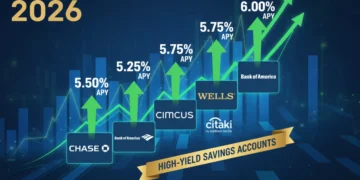
Maximize Savings: Top Banks 4.5% APY in 2026

Discover top banks offering 4.5% APY or more in 2026 to maximize your savings account yields, focusing on online institutions and competitive interest rates.
Are you looking to make your money work harder for you? In 2026, finding a high-yield savings account is crucial for wealth growth. This guide will help you navigate the landscape of banks offering high-yield savings accounts with 4.5% APY or more, ensuring your financial future is brighter.
Understanding high-yield savings accounts
High-yield savings accounts are a cornerstone of smart financial planning, offering significantly better interest rates than traditional savings accounts. These accounts typically leverage online-only operations, reducing overhead costs and allowing them to pass those savings onto you in the form of higher annual percentage yields (APYs).
The distinction between APY and annual interest rate is important. While both reflect how much you earn, APY takes into account the effect of compounding interest, giving you a more accurate picture of your actual earnings over a year. This compounding effect, especially at rates of 4.5% or higher, can dramatically accelerate your savings growth.
The power of compounding
Compounding interest is essentially interest earning interest. When your savings account pays interest, that interest is then added to your principal balance. In subsequent periods, you earn interest not only on your original deposit but also on the accumulated interest. This snowball effect is why even a seemingly small difference in APY can lead to substantial gains over time.
- Faster Growth: Higher APYs mean your money grows more quickly.
- Inflation Hedge: A strong APY helps combat the eroding effects of inflation on your purchasing power.
- Liquid Access: Unlike some investments, high-yield savings accounts typically offer easy access to your funds.
In essence, a high-yield savings account is not just a place to store your money; it is an active tool for wealth accumulation. By understanding how these accounts work and the benefits of compounding, you are better equipped to make informed decisions about where to keep your funds.
Key factors to consider when choosing a bank
Selecting the right bank for your high-yield savings account involves more than just looking at the APY. While a 4.5% APY or more is certainly attractive, other factors play a crucial role in your overall banking experience and financial security. It is vital to consider these elements to ensure the bank aligns with your financial needs and preferences.
FDIC insurance and security
One of the most critical aspects is confirming that the bank is FDIC-insured. This insurance protects your deposits up to $250,000 per depositor, per insured bank, for each account ownership category, providing peace of mind. Without FDIC insurance, your savings could be at risk if the bank fails.
Beyond FDIC insurance, evaluate the bank’s security measures. Look for features like two-factor authentication, encryption, and fraud protection. A secure online banking platform is paramount, especially when managing your money digitally.
Fees and minimum balance requirements
Some high-yield savings accounts come with hidden fees or stringent minimum balance requirements that could erode your earnings. Always review the fee schedule carefully. Common fees include monthly maintenance fees, excessive withdrawal fees, or fees for falling below a minimum balance. Ideally, seek accounts with no monthly fees and manageable minimums, or even no minimum at all.
- Monthly Fees: Can significantly reduce your effective APY.
- Minimum Balance: Ensure you can comfortably meet any required thresholds.
- Withdrawal Limits: Understand any restrictions on how often you can access your funds.
The goal is to find an account where the high APY is not offset by costly fees or inaccessible funds. Transparency in fees is a strong indicator of a trustworthy financial institution.
Top online banks offering 4.5% APY or more in 2026
The landscape of high-yield savings accounts is dynamic, with new players emerging and established institutions adjusting their rates. In 2026, online-only banks continue to lead the charge in offering the most competitive APYs, often surpassing traditional brick-and-mortar banks. These institutions capitalize on lower operational costs, passing the benefits directly to their customers.
When evaluating these top contenders, it is essential to look beyond just the APY. Consider their customer service reputation, ease of use of their digital platforms, and any additional features they might offer, such as budgeting tools or seamless integration with other financial products.
Spotlight on leading online institutions
Several online banks have consistently offered attractive rates and robust services. While specific rates fluctuate, institutions like Ally Bank, Marcus by Goldman Sachs, Discover Bank, and Capital One 360 have historically been at the forefront of high-yield offerings. These banks are known for their user-friendly interfaces and strong digital capabilities.

For example, a bank might offer a 4.6% APY with no minimum balance, while another could offer 4.8% but require a $1,000 opening deposit. Your choice should align with your financial capacity and how you plan to manage your savings.
- Ally Bank: Known for competitive rates and excellent customer service.
- Marcus by Goldman Sachs: Offers strong APYs with no fees or minimums.
- Discover Bank: Combines high yields with a full suite of banking products.
- Capital One 360: Provides competitive rates and integrated banking solutions.
Always check the most current rates and terms directly on the banks’ websites before making a decision, as these can change frequently based on market conditions and Federal Reserve policy.
Strategies for maximizing your savings growth
Simply opening a high-yield savings account is the first step; actively managing it with strategic approaches can significantly amplify your returns. Maximizing your savings growth involves consistent effort and smart financial habits, leveraging the benefits of a high APY to their fullest potential. These strategies extend beyond just depositing money; they encompass regular contributions, intelligent fund allocation, and a proactive mindset.
One key strategy is to automate your savings. Setting up automatic transfers from your checking account to your high-yield savings account ensures consistent contributions without requiring constant manual effort. Even small, regular deposits can accumulate substantially over time, especially with a strong APY.
Automating contributions and setting goals
Automated savings remove the temptation to spend and build a disciplined habit. Combine this with clear financial goals, such as saving for a down payment, an emergency fund, or a vacation. When you have a specific target, you are more motivated to stick to your savings plan. Break down large goals into smaller, manageable milestones to maintain momentum.
- Set up direct deposit: Have a portion of your paycheck automatically go to savings.
- Use budgeting apps: Track spending and identify areas to save more.
- Review progress regularly: Adjust your contributions as your income or expenses change.
Another powerful strategy is to understand and utilize the ‘bucket’ approach to savings. Instead of one large savings pot, create sub-accounts or mental buckets for different goals. This helps in visualizing your progress for each specific objective, making your savings journey more tangible and motivating.
The impact of economic trends on APY rates
Annual Percentage Yields (APYs) on savings accounts do not exist in a vacuum; they are heavily influenced by broader economic trends and central bank policies. Understanding these dynamics is crucial for anyone looking to maximize their savings, as it helps in anticipating rate changes and making timely decisions. In 2026, these influences remain as significant as ever, shaping the offerings from top banks.
The primary driver of APY rates is the federal funds rate set by the Federal Reserve. When the Fed raises this benchmark rate, banks typically follow suit by increasing their savings rates to attract deposits. Conversely, a decrease in the federal funds rate often leads to lower APYs. Monitoring the Fed’s statements and economic forecasts can provide valuable insights into future rate movements.
Inflation and the federal funds rate
Inflation plays a critical role in the Federal Reserve’s decisions regarding interest rates. High inflation often prompts the Fed to raise rates to cool down the economy, which in turn can lead to higher savings APYs. Conversely, in periods of low inflation or economic slowdowns, rates may be lowered to stimulate growth. For savers, a high APY is particularly valuable during inflationary periods, as it helps preserve purchasing power.
Beyond the federal funds rate, other economic indicators such as GDP growth, unemployment rates, and consumer spending can also subtly influence bank decisions on savings rates. Banks need to remain competitive while also managing their own liquidity and lending activities.
- Federal Reserve policy: Directly impacts the federal funds rate, influencing APYs.
- Inflation levels: High inflation can lead to higher rates to combat erosion of purchasing power.
- Economic growth: Strong economic growth might see banks offering higher rates to attract capital.
Staying informed about these economic trends allows you to be proactive. If you anticipate a period of rising rates, it might be strategic to hold off on locking into certain long-term investments and keep funds more liquid in a high-yield savings account, ready to capture even better APYs.
Beyond savings accounts: other high-yield options
While high-yield savings accounts are excellent for accessible funds and short-to-medium term goals, exploring other high-yield options can further diversify your portfolio and potentially offer even greater returns for funds you don’t need immediate access to. These alternatives can complement your savings strategy, providing different levels of liquidity and risk.
Certificates of Deposit (CDs) are a popular choice for those willing to lock up their money for a fixed period. In exchange for this commitment, CDs often offer higher interest rates than savings accounts, especially for longer terms. The rates are fixed, providing predictability, but early withdrawals typically incur penalties.
Exploring CDs and money market accounts
Money market accounts (MMAs) offer a hybrid approach, combining some features of both savings and checking accounts. They usually come with higher interest rates than traditional savings accounts and often include check-writing privileges and debit card access. However, MMAs might have higher minimum balance requirements and transaction limits compared to standard savings accounts.
For those with a higher risk tolerance and longer time horizons, certain investment vehicles can offer significantly greater returns. These include:
- Treasury Bills (T-Bills): Short-term government securities offering competitive yields.
- Short-term bond funds: Invest in a portfolio of bonds, providing diversification.
- Dividend stocks or ETFs: Offer potential for both capital appreciation and income.
Each of these options comes with its own set of risks and rewards. It is crucial to assess your personal financial situation, risk tolerance, and time horizon before allocating funds to these alternatives. Consulting with a financial advisor can provide tailored guidance to ensure your investment strategy aligns with your overall financial goals.
The future of high-yield savings in 2026 and beyond
The financial landscape is ever-evolving, and predicting the exact trajectory of high-yield savings accounts in 2026 and beyond requires an understanding of ongoing technological advancements, regulatory changes, and shifts in consumer behavior. However, certain trends suggest that high-yield options will continue to be a vital component of personal finance, adapting to new economic realities.
Digital innovation is a key driver. As more banking operations move online, the efficiency gains will likely continue to translate into competitive APYs. Fintech companies, in particular, are poised to introduce even more sophisticated tools and platforms, making it easier for consumers to find and manage high-yield accounts.
Technological advancements and regulatory shifts
Artificial intelligence and machine learning are increasingly being used by financial institutions to personalize banking experiences and optimize interest rate offerings. This means that in the future, your savings account might offer dynamic rates tailored to your specific financial habits or market conditions.
Regulatory frameworks also play a crucial role. Governments and central banks are continually evaluating policies to ensure financial stability and consumer protection. Changes in these regulations could impact how banks operate and the rates they are able to offer. For instance, new rules around capital requirements could influence banks’ willingness to offer ultra-high APYs.
- AI-driven personalization: Tailored rates and financial advice.
- Blockchain technology: Potential for more secure and efficient transactions.
- Increased competition: More fintech players entering the market.
The consumer’s role is also evolving. With greater access to information and comparison tools, individuals are becoming more financially savvy and demanding better returns. This increased consumer awareness will likely push banks to maintain competitive high-yield offerings, ensuring that maximizing savings remains a priority for many.
| Key Aspect | Brief Description |
|---|---|
| High APY Banks | Online banks often offer 4.5%+ APY due to lower overhead costs. |
| FDIC Insurance | Essential for protecting deposits up to $250,000 per account. |
| Economic Influence | Federal Reserve rates and inflation significantly impact APY trends. |
| Savings Strategies | Automate contributions and set clear financial goals for growth. |
Frequently asked questions about high-yield savings
APY, or Annual Percentage Yield, reflects the total amount of interest earned on a deposit account over one year, taking compounding into account. An interest rate is simply the percentage charged on a loan or paid on a deposit, without considering the effect of compounding.
Yes, if they are offered by FDIC-insured banks. The Federal Deposit Insurance Corporation (FDIC) protects your deposits up to $250,000 per depositor, per insured bank, for each account ownership category, ensuring your money is secure.
Generally, yes. High-yield savings accounts typically offer good liquidity, allowing you to transfer funds to a linked checking account or withdraw money as needed. However, some accounts may have limits on the number of monthly transactions.
While many top online high-yield accounts have no monthly fees or minimum balance requirements, it is crucial to check a bank’s specific terms. Some may charge fees for certain services or if your balance falls below a set threshold.
APY rates for high-yield savings accounts can change frequently, often influenced by the Federal Reserve’s interest rate decisions and broader economic conditions. It is advisable to regularly check your bank’s current rates to stay informed.
Conclusion
In 2026, maximizing your savings account yields by seeking out banks offering 4.5% APY or more is a smart financial move. By understanding the nuances of APY, prioritizing FDIC insurance, and staying informed about economic trends, you can make strategic decisions that significantly enhance your financial growth. Remember to combine these insights with disciplined savings habits for the most impactful results, ensuring your money works as hard as you do.