AI in Investment Decisions: 2026 Algorithmic Trading Outlook

By 2026, artificial intelligence will fundamentally reshape investment decisions and algorithmic trading, offering unprecedented analytical capabilities and efficiency gains for market participants.
The financial landscape is in constant flux, but few forces are as transformative as artificial intelligence. By 2026, AI investment decisions will not just be an advantage but a fundamental component of successful algorithmic trading strategies, redefining how capital is managed and markets operate.
The Dawn of AI-Driven Investment: A New Era
The integration of Artificial Intelligence (AI) into the financial sector has been a gradual yet relentless process. What began with simple rule-based systems has rapidly evolved into sophisticated machine learning models capable of processing vast amounts of data at speeds unimaginable to human analysts. This evolution is fundamentally altering the approach to investment decisions, moving from intuition-driven strategies to data-centric methodologies.
By 2026, AI’s presence will be ubiquitous, influencing everything from retail investment platforms to high-frequency trading desks. This shift promises enhanced efficiency, reduced human error, and the ability to uncover patterns that remain hidden to traditional analytical methods. The sheer volume and velocity of market data necessitate tools that can not only cope but thrive under such conditions, making AI an indispensable partner for investors.
Historical Context and Rapid Evolution
The journey of AI in finance started with basic predictive models and has accelerated dramatically in recent years. Early applications focused on automating repetitive tasks and providing rudimentary risk assessments. However, advancements in computational power and algorithms have unlocked far greater potential.
- Early Predictive Models: Simple regression and time-series analysis.
- Machine Learning Emergence: Introduction of supervised and unsupervised learning for pattern recognition.
- Deep Learning Revolution: Neural networks processing unstructured data like news and social media.
- Reinforcement Learning: AI agents learning optimal strategies through trial and error in simulated environments.
This rapid evolution means that financial professionals must continually adapt their skill sets and embrace new technologies. The competitive edge will increasingly belong to those who can effectively leverage AI to inform and execute their investment strategies.
The foundational impact of AI on investment decisions is undeniable. It’s not merely a tool for automation but a catalyst for entirely new approaches to market analysis and strategy formulation. Understanding this historical trajectory is crucial for appreciating its projected influence by 2026.
Algorithmic Trading 2.0: AI at the Core
Algorithmic trading, once the domain of quantitative analysts using predefined rules, is undergoing a profound transformation with the advent of advanced AI. By 2026, AI will be central to designing, optimizing, and executing trading algorithms, moving beyond simple programmed instructions to adaptive, learning systems. This represents a significant leap from traditional algorithmic trading, often referred to as Algorithmic Trading 2.0.
The ability of AI to learn from historical data, identify complex correlations, and even predict market movements with a higher degree of accuracy than humanly possible is reshaping the competitive landscape. These sophisticated algorithms can react to market events in milliseconds, capitalizing on fleeting opportunities and mitigating risks before human intervention is feasible.
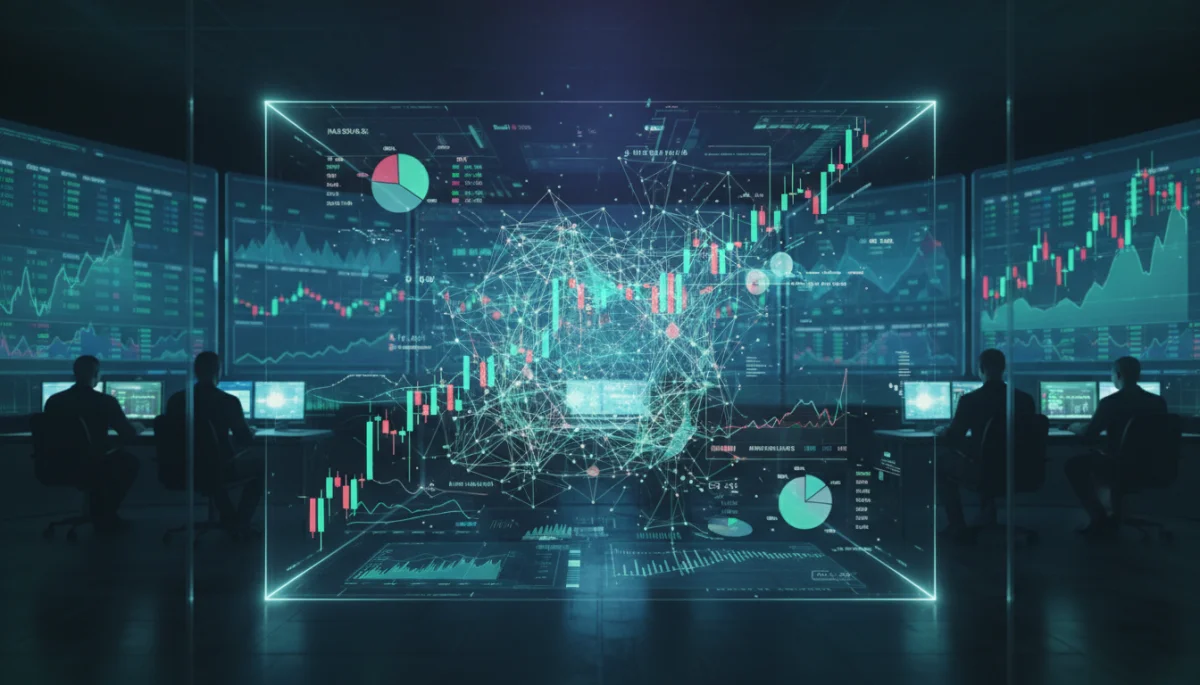
AI’s role extends to various facets of algorithmic trading, from strategy development to execution and post-trade analysis. It empowers traders to develop more robust and resilient strategies that can adapt to ever-changing market conditions, a critical advantage in volatile financial environments.
Enhanced Strategy Development with Machine Learning
Machine learning models are increasingly used to generate novel trading strategies. These models can analyze vast datasets, including macroeconomic indicators, company fundamentals, social media sentiment, and even satellite imagery, to uncover alpha-generating signals.
- Pattern Recognition: Identifying hidden trends and anomalies in market data.
- Sentiment Analysis: Gauging market mood from news articles and social media.
- Predictive Modeling: Forecasting price movements and volatility with greater precision.
- Optimal Portfolio Construction: Dynamically adjusting asset allocations based on real-time data.
The sophistication of these AI-driven strategies means that human traders will increasingly focus on overseeing and refining these AI systems rather than manually executing trades. This collaborative approach between human expertise and AI efficiency is defining the future of algorithmic trading.
The shift towards AI-centric algorithmic trading is not just about speed; it’s about intelligence. AI provides the capability to process, interpret, and act upon information in ways that were previously unimaginable, fundamentally altering the dynamics of market participation.
Predictive Analytics and Market Forecasting in 2026
By 2026, predictive analytics, powered by advanced AI, will revolutionize market forecasting, offering investors deeper insights and more accurate predictions. Gone are the days when forecasting relied solely on historical price charts and economic reports. AI models can now integrate a multitude of alternative data sources, providing a holistic view of market sentiment and potential movements.
The accuracy and breadth of these predictive models will enable investors to make more informed decisions, anticipating shifts in demand, supply, and investor behavior. This capability is particularly crucial in fast-moving markets where even a slight predictive edge can lead to significant gains.
AI’s ability to identify non-linear relationships and complex interactions within data sets surpasses traditional statistical methods. This means uncovering subtle indicators that might signal an impending market correction or a lucrative investment opportunity, far in advance of conventional analysis.
Leveraging Alternative Data Sources
One of AI’s most significant contributions to predictive analytics is its capacity to process and derive insights from alternative data. This includes information that was previously too unstructured or voluminous for human analysis.
- Satellite Imagery: Tracking economic activity, such as parking lot occupancy or crop yields.
- Credit Card Transactions: Gaining real-time insights into consumer spending habits.
- Web Scraped Data: Analyzing product reviews, job postings, and supply chain information.
- Geospatial Data: Understanding demographic shifts and their impact on local economies.
These diverse data streams, when fed into sophisticated AI models, create a powerful forecasting engine. The insights derived are not just about what has happened, but what is likely to happen, offering a forward-looking perspective that is invaluable in investment planning.
The evolution of predictive analytics through AI is not just about better forecasts; it’s about fundamentally changing the informational advantage in financial markets. Investors who embrace these technologies will be better positioned to navigate the complexities of the 2026 financial landscape.
Risk Management and Portfolio Optimization with AI
The volatile nature of financial markets necessitates robust risk management and intelligent portfolio optimization. By 2026, AI will be indispensable in these areas, offering dynamic and proactive solutions that far exceed traditional methods. AI systems can continuously monitor market conditions, identify emerging risks, and suggest optimal adjustments to portfolios in real-time.
This capability moves beyond static risk assessments to a more adaptive framework, where potential threats are anticipated and mitigated before they fully materialize. For investors, this translates into greater portfolio resilience and a more stable return profile, even amidst market turmoil.
AI also excels in identifying complex dependencies and correlations between assets, which are often overlooked by human analysts. This allows for a more nuanced understanding of diversification and risk aggregation, leading to truly optimized portfolios tailored to specific investor goals and risk appetites.
Dynamic Risk Assessment and Mitigation
AI models can perform continuous risk assessments, learning from new data and adapting their understanding of market dynamics. This allows for the identification of subtle shifts in risk factors that might otherwise go unnoticed.
- Stress Testing: Simulating various market scenarios to evaluate portfolio resilience.
- Anomaly Detection: Identifying unusual trading patterns that could indicate fraud or market manipulation.
- Liquidity Risk Monitoring: Assessing the ease with which assets can be bought or sold without impacting their price.
- Credit Risk Analysis: Evaluating the creditworthiness of counterparties and securities with greater accuracy.
Furthermore, AI-driven systems can recommend immediate actions to mitigate identified risks, such as rebalancing a portfolio or adjusting hedging strategies. This proactive approach to risk management is a cornerstone of successful investing in the modern era.
The role of AI in risk management and portfolio optimization is transformative, providing investors with powerful tools to protect their capital and maximize returns. Its ability to process, analyze, and react to complex data in real-time is a game-changer for financial stability.
Ethical Considerations and Regulatory Challenges
As AI’s influence on investment decisions and algorithmic trading grows, so do the ethical considerations and regulatory challenges. By 2026, regulators worldwide will be grappling with how to ensure fair, transparent, and stable markets in an AI-driven financial ecosystem. The complexity of AI models, often referred to as ‘black boxes,’ raises concerns about accountability and explainability, particularly when errors or market anomalies occur.
The potential for AI to exacerbate market volatility, create flash crashes, or even contribute to systemic risk is a significant area of concern. Ensuring that AI systems operate within ethical boundaries and do not lead to discriminatory outcomes is paramount for maintaining investor trust and market integrity.
Regulatory frameworks must evolve rapidly to keep pace with technological advancements, balancing innovation with necessary oversight. This involves developing new standards for AI model validation, transparency requirements, and mechanisms for addressing algorithmic bias.
Addressing Algorithmic Bias and Explainability
Algorithmic bias, often unintentional, can arise from biased training data or flawed model design, leading to unfair or suboptimal outcomes. Ensuring AI models are fair and their decisions are explainable is a critical challenge.
- Data Governance: Implementing strict protocols for data collection and curation to minimize bias.
- Explainable AI (XAI): Developing methods to interpret and understand AI model decisions.
- Auditing and Validation: Regular independent audits of AI systems to ensure compliance and fairness.
- Regulatory Sandboxes: Creating controlled environments for testing new AI financial products under regulatory supervision.
The development of robust ethical guidelines and a clear regulatory roadmap is essential for the healthy growth of AI in finance. Without these safeguards, the potential benefits of AI could be overshadowed by unforeseen risks and public distrust.
Navigating the ethical and regulatory landscape of AI in investment decisions will require ongoing collaboration between financial institutions, technology providers, regulators, and academics. This collective effort is crucial for harnessing AI’s power responsibly.
The Future Landscape: Human-AI Collaboration
Looking ahead to 2026 and beyond, the future of investment decisions and algorithmic trading will not be about AI replacing humans entirely, but rather about effective human-AI collaboration. While AI will handle the heavy lifting of data analysis, pattern recognition, and high-speed execution, human expertise will remain vital for strategic oversight, ethical considerations, and adapting to unforeseen market shifts.
This symbiotic relationship leverages the strengths of both entities: AI’s computational power and objectivity, combined with human intuition, creativity, and understanding of complex socio-economic factors. The most successful financial firms will be those that master this collaborative paradigm, integrating AI tools seamlessly into their workflows.
The role of the financial professional will evolve, shifting from manual data crunching to interpreting AI outputs, questioning assumptions, and making high-level strategic decisions. This new dynamic promises a more efficient, insightful, and potentially more profitable financial ecosystem.
Evolving Roles for Financial Professionals
The skills required for financial professionals are changing, with an increased emphasis on understanding AI capabilities and limitations.
- AI Ethicists: Ensuring AI models adhere to ethical guidelines and regulatory standards.
- Data Scientists: Developing and refining AI algorithms for financial applications.
- AI Strategists: Integrating AI insights into overall investment strategies.
- Hybrid Traders: Professionals who combine traditional trading expertise with AI tool proficiency.
Training and upskilling initiatives will be crucial to prepare the workforce for these evolving roles. The blend of financial acumen and technological literacy will define the next generation of successful investors and traders.
The future landscape of AI in investment decisions is one of partnership. By fostering effective human-AI collaboration, the financial industry can unlock unprecedented potential, driving innovation and creating more resilient and intelligent markets by 2026.
| Key Aspect | Description in 2026 |
|---|---|
| Algorithmic Trading | AI moves beyond rule-based to adaptive, learning systems for strategy and execution. |
| Predictive Analytics | Enhanced market forecasting using diverse alternative data sources. |
| Risk Management | Dynamic, real-time risk assessment and proactive mitigation strategies. |
| Human-AI Collaboration | Integration of AI tools with human oversight for strategic decision-making. |
Frequently Asked Questions About AI in Investing
By 2026, AI will empower day traders with advanced predictive models and rapid execution capabilities. It will analyze vast datasets, identify fleeting opportunities, and manage risks in real-time, significantly enhancing decision-making speed and accuracy beyond human capacity. Human traders will focus more on strategy development.
Key risks include algorithmic bias from flawed data, potential for flash crashes due to rapid automated responses, lack of explainability in complex models, and the challenge of regulatory oversight. Ensuring robust validation and ethical guidelines is crucial to mitigate these potential drawbacks.
No, AI is unlikely to fully replace human financial advisors by 2026. Instead, it will augment their capabilities, handling data analysis and routine tasks. Advisors will focus on client relationships, complex financial planning, emotional intelligence, and strategic guidance that AI cannot replicate.
AI processes alternative data like satellite imagery, social media sentiment, and credit card transactions to uncover unique market insights. This data provides real-time indicators of economic activity and consumer behavior, offering a predictive edge beyond traditional financial reports for more informed investment decisions.
Finance professionals will need strong analytical skills, an understanding of AI/machine learning concepts, data interpretation abilities, and critical thinking. Ethical reasoning and the capacity for human-AI collaboration will also be crucial for navigating the sophisticated, AI-enhanced financial markets of 2026.
Conclusion
The year 2026 marks a significant milestone in the integration of AI into investment decisions and algorithmic trading. We are moving beyond the experimental phase into an era where AI is a core component of financial strategy, offering unparalleled capabilities in data analysis, market prediction, and risk management. While the benefits are immense, addressing ethical concerns and regulatory challenges will be crucial for sustainable growth. The future of finance is a collaborative one, where human expertise and artificial intelligence combine to forge more intelligent, efficient, and resilient markets for all participants.
Related Posts: