Understanding 2026 VA and USDA loan benefits is crucial for eligible homebuyers seeking favorable terms, including no down payment options and competitive interest rates, to achieve their homeownership dreams.
By: Rafaela on September 23, 2026
Understanding 2026 VA and USDA loan benefits is crucial for eligible homebuyers seeking favorable terms, including no down payment options and competitive interest rates, to achieve their homeownership dreams.
For many aspiring homeowners, navigating the complex world of mortgages can feel daunting. However, several government-backed programs offer unique advantages that can make homeownership a reality. This guide is dedicated to Exploring Government-Backed Loans: A 2026 Guide to VA and USDA Loan Benefits, providing a comprehensive overview of how these programs can serve you.
Understanding VA Loans: Designed for Service Members
VA loans are an invaluable benefit exclusively available to eligible U.S. veterans, active-duty service members, and certain surviving spouses. These loans are guaranteed by the U.S. Department of Veterans Affairs, offering significant advantages over conventional mortgages. The primary goal of the VA loan program is to assist those who have served our nation in achieving the dream of homeownership without the burden of a substantial down payment.
In 2026, the core principles of VA loans remain steadfast, emphasizing accessibility and financial relief for military families. It’s important to understand the specific criteria for eligibility and the unique features that set VA loans apart.
Eligibility for VA Home Loans
Determining your eligibility is the first step in leveraging VA loan benefits. The VA establishes specific service requirements that must be met to qualify for this program. Generally, this includes active duty service, honorable discharge, or serving a minimum number of days during wartime or peacetime periods.
Service Requirements: Varies based on when you served (e.g., 90 consecutive days of active service during wartime, 181 days during peacetime).
Certificate of Eligibility (COE): This document confirms your eligibility for VA home loan benefits and is essential for the application process.
Surviving Spouses: Certain surviving spouses of veterans who died in service or from a service-connected disability may also be eligible.
Key Benefits of VA Loans
The advantages of a VA loan are numerous and designed to alleviate common financial hurdles associated with purchasing a home. These benefits are a direct recognition of the sacrifices made by service members and their families.
No Down Payment: For most eligible borrowers, a VA loan requires no down payment, a significant advantage compared to conventional and FHA loans.
No Private Mortgage Insurance (PMI): Unlike conventional loans with less than 20% down, VA loans do not require PMI, leading to lower monthly payments.
Competitive Interest Rates: VA loans often feature lower interest rates than other loan types, saving borrowers money over the life of the loan.
Limited Closing Costs: The VA limits the closing costs lenders can charge, further reducing the financial burden on the borrower.
In conclusion, VA loans offer unparalleled benefits for those who have served, making homeownership more attainable and affordable. Understanding the eligibility criteria and key advantages is crucial for service members and veterans looking to purchase a home in 2026.
Delving into USDA Loans: Rural Homeownership Opportunities
USDA loans, guaranteed by the U.S. Department of Agriculture, are another vital government-backed program aimed at promoting homeownership in designated rural and suburban areas. These loans are specifically designed to help low-to-moderate income individuals and families purchase safe and affordable homes, fostering community development in less densely populated regions.
For 2026, USDA loan programs continue to play a critical role in supporting rural economies and ensuring access to housing where conventional financing might be scarce. It’s essential to grasp both the geographic and income requirements to determine if a USDA loan is the right fit for your homebuying journey.
Geographic and Income Eligibility
Unlike VA loans, USDA loans have specific geographic and income restrictions. The property must be located in an eligible rural area, as defined by the USDA, and the applicant’s household income must not exceed certain limits.
Eligible Areas: The USDA provides an online eligibility map where you can check if a specific property address qualifies. These areas are typically outside major metropolitan centers.
Income Limits: Household income cannot exceed 115% of the median income for the area, with adjustments for household size.
Primary Residence: The home must be used as the borrower’s primary residence.
Advantages of USDA Home Loans
USDA loans come with several attractive benefits, particularly for those looking to purchase a home in qualifying rural areas. These advantages make homeownership more accessible to a broader range of individuals.
No Down Payment: Similar to VA loans, USDA direct and guaranteed loans often require no down payment for eligible borrowers.
Low Mortgage Insurance: While USDA loans do have mortgage insurance, both the upfront and annual fees are typically lower than those for FHA loans.
Competitive Interest Rates: USDA loans offer competitive interest rates, which can lead to lower monthly payments and significant savings over time.
Flexible Credit Requirements: While a good credit score is always beneficial, USDA loans can be more flexible with credit requirements compared to conventional loans.
In summary, USDA loans are a powerful tool for promoting rural homeownership, offering significant financial benefits to eligible individuals and families. Understanding the specific geographic and income criteria is key to unlocking these opportunities in 2026.
Comparing VA and USDA Loan Benefits
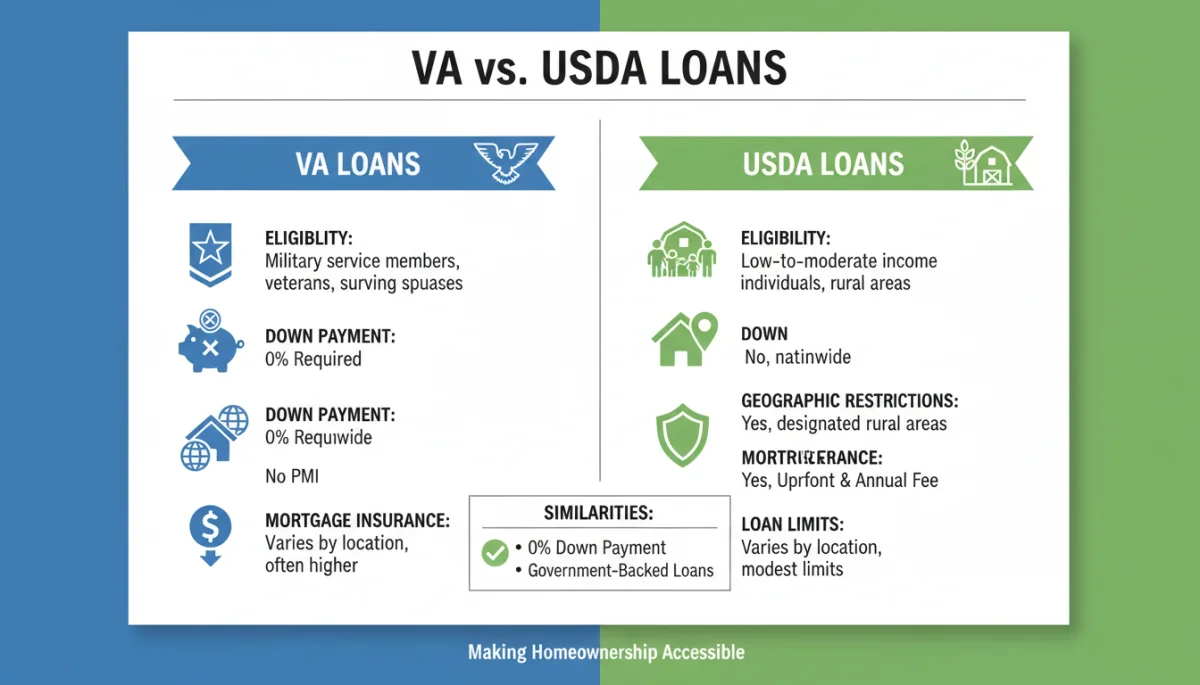
While both VA and USDA loans are government-backed and offer excellent benefits, they cater to different segments of the population and have distinct eligibility requirements. A clear understanding of these differences is crucial for potential homebuyers to determine which program best suits their needs.
Both programs share the common goal of making homeownership more accessible, yet their pathways to achieving this goal diverge significantly. Let’s look at a comparative analysis of their key features.
Key Distinctions and Similarities
The most significant difference lies in who they serve. VA loans are exclusively for service members and veterans, while USDA loans target low-to-moderate income individuals in rural areas. However, both offer the advantage of no down payment, a major draw for many homebuyers.
Target Audience: VA for military personnel; USDA for rural low-to-moderate income individuals.
Geographic Restrictions: VA loans have no geographic restrictions; USDA loans are limited to designated rural areas.
Mortgage Insurance: VA loans generally have no ongoing PMI; USDA loans have both upfront and annual guarantee fees (similar to mortgage insurance).
Down Payment: Both often allow for 0% down payment for eligible borrowers.
Choosing the Right Loan for You
The decision between a VA and USDA loan, or even a conventional loan, depends entirely on your individual circumstances. Consider your service history, income, and desired location when making your choice. It’s often beneficial to consult with a lender who specializes in government-backed loans to explore all your options.
Ultimately, the best loan program is the one that aligns with your eligibility, financial situation, and homebuying goals. Both VA and USDA loans provide unique pathways to homeownership that should be carefully considered.
The Application Process for Government-Backed Loans
Applying for a government-backed loan, whether it’s a VA or USDA loan, involves several key steps. While the specifics may vary slightly between the two, the general process aims to verify eligibility, assess financial stability, and ensure the property meets program standards. Understanding this process can help streamline your homebuying journey.
Preparation is crucial. Gathering the necessary documentation and understanding each stage of the application can significantly reduce stress and potential delays.
Steps for VA Loan Application
For VA loans, obtaining your Certificate of Eligibility (COE) is paramount. This document confirms your service and entitlement to VA benefits. Once you have your COE, you can begin working with a VA-approved lender.
Obtain COE: Apply through the VA eBenefits portal, your lender, or by mail.
Find a Lender: Work with a lender experienced in VA loans.
Get Pre-Approved: This helps you understand how much you can afford and shows sellers you are a serious buyer.
Find a Home and Make Offer: Ensure the property meets VA minimum property requirements.
VA Appraisal and Underwriting: The VA requires an appraisal to ensure the home’s value and condition.
Close on Your Loan: Sign the final documents and become a homeowner.
Steps for USDA Loan Application
USDA loan applications also require careful attention to detail, particularly regarding property location and income verification. Like VA loans, working with a lender familiar with USDA guidelines is highly recommended.
Verify Property Eligibility: Use the USDA’s online mapping tool to confirm the home’s location qualifies.
Check Income Eligibility: Ensure your household income is within the USDA limits for your area.
Find a USDA-Approved Lender: Seek out lenders specializing in USDA loans.
Pre-Qualification/Pre-Approval: Understand your borrowing capacity.
Property Appraisal and Inspection: The home must meet USDA safety and structural requirements.
Underwriting and Closing: Final review of documents and signing.
In conclusion, while the application processes for VA and USDA loans have their unique requirements, both emphasize thorough documentation and working with knowledgeable lenders. Preparing for these steps will undoubtedly lead to a smoother and more successful homebuying experience.
Maximizing Your Government Loan Benefits in 2026
To truly leverage the advantages offered by VA and USDA loans in 2026, it’s essential to go beyond just understanding their basic features. Strategic planning, careful research, and proactive engagement with the process can significantly enhance your homeownership journey and financial well-being.
These loans are designed to provide substantial support, but maximizing their potential requires a thoughtful approach and an awareness of available resources.
Tips for VA Loan Borrowers
For VA loan applicants, understanding the funding fee and how to potentially reduce or exempt it is a key consideration. Also, leveraging your eligibility for future loans is a powerful aspect of this benefit.
Understand the VA Funding Fee: This one-time fee can be financed into the loan or paid upfront. Certain veterans (e.g., those receiving VA disability compensation) are exempt.
Reuse Your Entitlement: Your VA loan benefit can often be used multiple times, even if you’ve used it before, provided certain conditions are met.
Consider Interest Rate Reduction Refinance Loan (IRRRL): If you already have a VA loan, an IRRRL can help you lower your interest rate without extensive documentation.
Tips for USDA Loan Borrowers
USDA loan borrowers should pay close attention to property location and income changes, as these are critical factors for eligibility. Exploring all available programs within the USDA umbrella can also be beneficial.
Monitor Property Eligibility: Regularly check the USDA eligibility map, as designated areas can change.
Stay Within Income Limits: Be mindful of your household income, especially if there are changes, as it impacts eligibility.
Explore Direct vs. Guaranteed Loans: Understand the difference between USDA’s direct loan program (for very low-income applicants) and the guaranteed loan program (for low-to-moderate income applicants).
In conclusion, maximizing your government loan benefits involves more than just qualifying; it requires a proactive approach to understanding fees, future eligibility, and program nuances. By doing so, borrowers can truly unlock the full potential of these valuable homeownership programs.
Potential Challenges and How to Overcome Them
While government-backed loans offer incredible advantages, potential borrowers may encounter certain challenges during the process. Being aware of these hurdles and understanding how to navigate them can save time, reduce stress, and ultimately lead to a successful home purchase.
From property requirements to credit score considerations, addressing these challenges head-on is key to a smooth transaction. Proactive problem-solving is often the best defense.
Navigating Property Requirements
Both VA and USDA loans have specific property requirements designed to ensure the home is safe, sanitary, and structurally sound. This can sometimes lead to appraisal challenges.
VA Minimum Property Requirements (MPRs): Ensure the property meets basic safety and habitability standards. If issues arise, the seller may need to make repairs or the buyer may need to negotiate.
USDA Property Standards: Similar to VA, USDA properties must meet specific health and safety standards. Properties requiring significant repairs might not qualify.
Appraisal Discrepancies: If the appraisal comes in lower than the sales price, negotiation or additional funds from the buyer may be necessary.
Addressing Credit and Financial Hurdles
While government loans can be more flexible with credit than conventional loans, a strong financial profile is always beneficial. Addressing credit issues or managing debt before applying can significantly improve your chances.
Credit Score: While there isn’t a universal minimum, lenders often look for a score of 620-640 or higher. Work on improving your credit score if it’s lower.
Debt-to-Income (DTI) Ratio: Lenders will assess your DTI to ensure you can comfortably manage mortgage payments. Aim for a DTI below 41% for VA loans and adhere to USDA guidelines.
Documentation: Be prepared to provide extensive financial documentation, including tax returns, pay stubs, and bank statements.
In conclusion, overcoming challenges in the government loan application process often boils down to preparation, communication, and flexibility. By understanding potential obstacles and knowing how to address them, borrowers can confidently pursue their homeownership goals.
The Future of Government-Backed Loans in 2026 and Beyond
As we look to 2026 and beyond, the landscape of government-backed loans continues to evolve, adapting to economic shifts and housing market needs. While the fundamental benefits of VA and USDA loans are expected to remain, potential changes in regulations, interest rates, and program specifics could impact future borrowers.
Staying informed about these potential developments is crucial for anyone considering these valuable home financing options. The commitment to supporting homeownership for veterans and rural communities remains a priority.
Anticipated Trends and Policy Adjustments
Government programs are subject to legislative review and adjustments based on economic indicators and housing policy goals. While specific changes are hard to predict, general trends can be observed.
Interest Rate Fluctuations: Mortgage rates are influenced by broader economic conditions and Federal Reserve policies. Borrowers should monitor these trends.
Program Funding: The availability and terms of direct loan programs (like USDA Direct) can be influenced by congressional appropriations.
Eligibility Updates: While core eligibility is stable, minor adjustments to service requirements for VA or income/geographic definitions for USDA could occur.
Long-Term Impact on Homeownership
The enduring presence of VA and USDA loans underscores their significant role in fostering stable communities and providing pathways to homeownership that might otherwise be inaccessible. These programs contribute to economic growth and individual financial stability.
The long-term impact of these loans extends beyond individual home purchases, contributing to broader societal benefits by supporting veterans and promoting development in rural areas. Their continued availability is a testament to their success and importance.
In conclusion, the future of government-backed loans in 2026 and beyond is likely to see continued adaptation, but their core mission of supporting eligible homebuyers is expected to endure. Staying informed and prepared will be key for future applicants.
Key Feature
Description
VA Loans
No down payment, no PMI, competitive rates for eligible veterans and service members.
USDA Loans
0% down payment, low mortgage insurance for rural, low-to-moderate income buyers.
Eligibility
VA based on service; USDA based on income and property location.
Key Benefit
Both offer pathways to homeownership with reduced upfront costs.
Frequently Asked Questions About Government-Backed Loans
Who is eligible for a VA loan?▼
VA loans are available to eligible U.S. veterans, active-duty service members, National Guard and Reserve members, and certain surviving spouses. Eligibility is typically determined by service length and character of discharge, confirmed by a Certificate of Eligibility (COE).
Can I get a USDA loan if I live in a city?▼
No, USDA loans are specifically for properties located in designated rural and suburban areas. The U.S. Department of Agriculture provides an online eligibility map where you can check if a specific address qualifies for a USDA loan.
Do VA and USDA loans always require no down payment?▼
For most eligible borrowers, both VA and USDA guaranteed loans offer 0% down payment options. However, some USDA direct loans may require a small down payment depending on the applicant’s income and ability to pay, though this is less common.
What are the credit score requirements for these loans?▼
Neither the VA nor USDA sets a minimum credit score. However, individual lenders typically require a FICO score of 620-640 or higher to approve a loan. A stronger credit score generally leads to better interest rates and terms.
Are there any ongoing fees with VA and USDA loans?▼
VA loans generally do not have ongoing private mortgage insurance (PMI). However, they have a one-time VA funding fee. USDA loans include both an upfront guarantee fee and an annual guarantee fee, similar to mortgage insurance, which are typically lower than FHA fees.
Conclusion
Exploring Government-Backed Loans: A 2026 Guide to VA and USDA Loan Benefits reveals two powerful pathways to homeownership for deserving individuals. VA loans stand as a testament to our nation’s commitment to its service members, offering unparalleled benefits like no down payment and no PMI. Concurrently, USDA loans play a crucial role in fostering rural development by making homeownership accessible to low-to-moderate income families in specific geographic areas. Understanding the distinct eligibility criteria, application processes, and unique advantages of each program is paramount for potential homebuyers. By leveraging these government-backed options, many Americans can achieve the dream of owning a home, securing their financial future, and contributing to vibrant communities across the United States.