FDIC Insurance Limits 2026: Protecting Your Deposits Up to $250,000
The FDIC insures deposits up to $250,000 per depositor, per insured bank, for each account ownership category. This coverage is crucial for protecting your savings and investments against bank failures, offering peace of mind in the evolving financial landscape of 2026.
By: Rafaela on September 23, 2026
The FDIC insures deposits up to $250,000 per depositor, per insured bank, for each account ownership category, offering vital protection for your savings and investments against bank failures.
Navigating the complexities of personal finance requires a clear understanding of how your hard-earned money is protected. For depositors in the United States, a critical safeguard is the Federal Deposit Insurance Corporation (FDIC). This independent agency of the U.S. government plays a vital role in maintaining stability and public confidence in the nation’s financial system. This article will delve into FDIC insurance limits for 2026, explaining how your deposits up to $250,000 are protected and what you need to know to maximize your security.
The bedrock of deposit protection: what is FDIC insurance?
FDIC insurance is a fundamental component of financial security in the United States, providing a safety net for depositors. Established in 1933 during the Great Depression, its primary mission is to maintain stability and public confidence in the financial system. This protection extends to billions of deposit accounts across thousands of banks nationwide, ensuring that even if an insured bank fails, your money is safe.
Understanding the core function of the FDIC is crucial for every depositor. It’s not just about recovering funds; it’s about preventing widespread panic and economic disruption. When a bank collapses, the FDIC steps in to ensure depositors have access to their insured funds quickly, often within a few business days. This swift action helps to prevent a domino effect across the banking sector, preserving trust in financial institutions.
How FDIC insurance works
The FDIC insures various types of deposit accounts, from checking and savings to money market deposit accounts and Certificates of Deposit (CDs). This coverage is automatic for all accounts at FDIC-insured institutions; you don’t need to apply for it. The protection is backed by the full faith and credit of the U.S. government, making it one of the most reliable forms of financial security available.
Automatic Coverage: All deposits in an FDIC-insured bank are automatically covered.
Government Backing: Backed by the full faith and credit of the U.S. government.
Broad Scope: Covers checking, savings, money market, and CD accounts.
In essence, FDIC insurance acts as a shield, protecting your deposits from the unforeseen circumstances of a bank failure. It’s a powerful tool for financial stability, offering peace of mind to millions of Americans. Knowing that your money is secure allows you to focus on your financial goals rather than worrying about the safety of your principal.
Understanding the $250,000 insurance limit for 2026
The standard maximum deposit insurance amount (SMDIA) for 2026 remains at $250,000 per depositor, per insured bank, for each account ownership category. This limit is a cornerstone of the FDIC’s protection framework, designed to cover the vast majority of individual and business deposits. It’s important to grasp what this limit truly means for your financial planning.
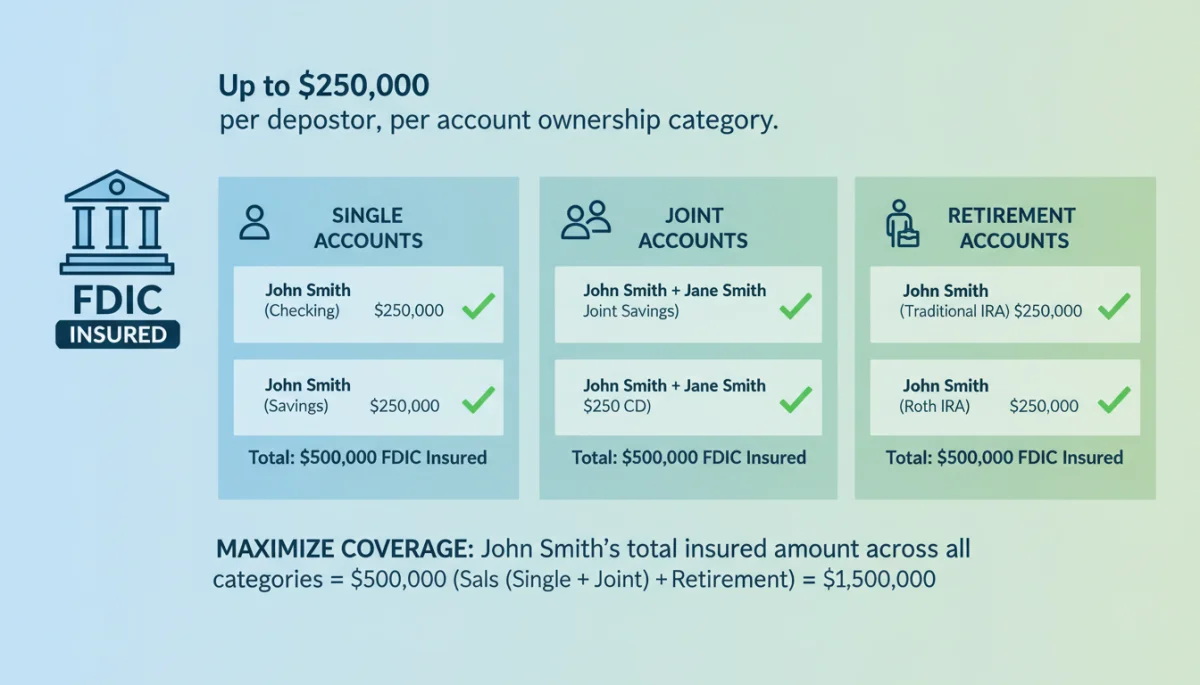
Many depositors mistakenly believe that the $250,000 limit applies to all their money across all accounts at a single bank. However, the key phrase here is ‘each account ownership category.’ This distinction allows for significantly more coverage if you structure your accounts strategically. For example, a single individual could have $250,000 in a checking account and another $250,000 in a retirement account at the same bank, both fully insured.
What the $250,000 limit covers
The $250,000 limit applies to the principal and any accrued interest up to the date of a bank failure. It’s not just the initial deposit that’s covered but also any earnings on that deposit. This comprehensive coverage ensures that your entire protected amount is accessible, even if a bank were to cease operations.
The types of accounts covered under this limit are diverse, including:
Checking accounts
Savings accounts
Money market deposit accounts (MMDAs)
Certificates of Deposit (CDs)
Official items such as cashier’s checks and money orders
It’s vital to note that certain financial products are not covered by FDIC insurance. These typically include investments like stocks, bonds, mutual funds, annuities, and safe deposit box contents. These products carry their own risks and are not considered deposits. Therefore, understanding the scope of what is and isn’t covered is essential for a complete financial protection strategy.
Maximizing your FDIC coverage through ownership categories
While the $250,000 limit might seem straightforward, the concept of ‘account ownership categories’ offers a powerful way to significantly increase your total FDIC insurance coverage. By understanding and utilizing these categories, you can protect substantial sums of money, often well beyond the standard $250,000 per person.
The FDIC recognizes several distinct ownership categories, and each one is insured separately up to the $250,000 limit at the same insured bank. This means that if you have deposits in different ownership categories, you can effectively multiply your coverage. This strategy is particularly beneficial for individuals or families with large sums of money that they wish to keep liquid and secure.
Common ownership categories
Let’s explore some of the most common ownership categories and how they can be used to maximize your protection:
Single Accounts: Accounts owned by one person in their name. This includes sole proprietorship accounts.
Joint Accounts: Accounts owned by two or more people, with equal rights to withdraw funds. Each co-owner’s share is insured up to $250,000.
Retirement Accounts: Includes IRAs (Traditional, Roth, SEP, SIMPLE), self-directed 401(k)s, and other defined contribution plans. These are aggregated and insured separately up to $250,000 per participant.
Revocable Trust Accounts: Funds held in a revocable trust are insured up to $250,000 per unique beneficiary for each owner of the trust.
For example, a couple could have a joint checking account, a separate savings account for each individual, and individual retirement accounts. This arrangement could easily lead to coverage exceeding $1 million at a single institution, all fully insured by the FDIC. Strategic planning is key to leveraging these categories effectively.
It is important to consult with your bank or a financial advisor to ensure your accounts are properly titled and structured to receive the maximum possible FDIC insurance limits coverage. Misunderstandings about ownership categories can lead to underinsurance, which could be detrimental in the event of a bank failure. The FDIC provides numerous resources and tools on its website to help depositors calculate their coverage.
What is not covered by FDIC insurance?
While FDIC insurance provides robust protection for deposits, it’s equally important to understand what types of financial products and investments are not covered. This clarity helps depositors make informed decisions and avoid potential pitfalls, ensuring a comprehensive approach to financial security.
The FDIC’s primary focus is on protecting traditional deposit accounts. Therefore, products that are investment-oriented or carry inherent market risks typically fall outside its scope. Mistaking these products for insured deposits can lead to significant financial losses if the underlying investments perform poorly or the issuing institution fails.
Non-covered financial products
A clear distinction exists between insured deposits and uninsured investment products. Here are some common examples of what the FDIC does not insure:
Stocks, bonds, and mutual funds: These are investment products subject to market fluctuations and are not guaranteed by the FDIC.
Annuities: While often sold by banks, annuities are insurance products and are not FDIC-insured.
Life insurance policies: Similar to annuities, these are insurance products.
Safe deposit box contents: The physical contents of a safe deposit box are not insured by the FDIC.
Cryptocurrencies: Digital assets like Bitcoin or Ethereum are not considered deposits and are not FDIC-insured.
It’s crucial for consumers to recognize that just because a product is offered by a bank, it doesn’t automatically mean it’s FDIC-insured. Banks often act as brokers for a wide range of financial products, some of which carry their own risks and are not backed by government insurance. Always ask whether a product is ‘FDIC-insured’ before committing your funds.
Understanding these limitations is not meant to deter investment but rather to encourage a balanced approach to financial planning. Diversifying your assets and clearly understanding the protections (or lack thereof) associated with each financial product is a hallmark of sound financial management. Always verify the insurance status of any financial product you consider, especially in the context of evolving market conditions.
The importance of checking your bank’s FDIC status
Before entrusting your money to any financial institution, one of the most critical steps you can take is to verify its FDIC insurance status. This simple check provides immediate assurance that your deposits are protected up to the FDIC insurance limits. Operating with an uninsured institution carries significant risks, as your funds would not be protected in the event of a bank failure.
While most traditional banks in the United States are FDIC-insured, it’s not a universal guarantee. Some newer financial technology (fintech) companies or credit unions may operate under different regulatory frameworks. Credit unions, for instance, are typically insured by the National Credit Union Administration (NCUA), which provides similar protection but is a separate entity.
How to verify FDIC insurance
Verifying a bank’s FDIC status is straightforward and can be done through several reliable channels:
FDIC’s BankFind Tool: The official FDIC website offers a comprehensive tool called BankFind. You can search for any bank by name, location, or certificate number to confirm its insurance status.
Bank signage: Look for the official FDIC sign displayed prominently at the bank’s branches and on its website. This sign indicates that the institution is an FDIC member.
Account statements: Your bank statements should also include information about FDIC insurance.
Taking a few moments to confirm the FDIC status of your bank is a proactive measure that safeguards your financial well-being. It provides a layer of security that allows you to deposit your funds with confidence, knowing that the government stands behind your insured amounts. This vigilance is particularly important in an ever-changing financial landscape where new institutions and services emerge regularly.
Future outlook: potential changes to FDIC limits beyond 2026
While the FDIC insurance limits are set at $250,000 per depositor, per insured bank, per ownership category for 2026, it is natural to wonder about potential future adjustments. The financial landscape is dynamic, and regulatory bodies like the FDIC continually assess economic conditions and banking sector stability. Historically, these limits have been adjusted in response to significant economic events or legislative changes.
The $250,000 limit was made permanent in 2010 as part of the Dodd-Frank Wall Street Reform and Consumer Protection Act, following a temporary increase during the 2008 financial crisis. This permanence provides a level of stability and predictability for depositors. However, future economic shifts, inflation, or legislative initiatives could always prompt discussions about further adjustments.
Factors influencing future changes
Several factors could influence decisions regarding future FDIC insurance limits:
Inflation: A sustained period of high inflation could erode the real value of the $250,000 limit, potentially leading to calls for an increase to maintain its purchasing power.
Economic stability: Major economic crises or banking system stress could trigger temporary or permanent adjustments to restore public confidence.
Legislative action: Congress has the authority to change the FDIC insurance limits through new laws.
Any changes to the FDIC limits would typically undergo significant deliberation and public discourse. The FDIC’s primary goal is to balance the need for depositor protection with the costs imposed on insured institutions, which ultimately fund the insurance fund. Therefore, while the $250,000 limit is stable for 2026, staying informed about economic trends and legislative developments is always a wise strategy for long-term financial planning.
For now, depositors can rely on the robust protection provided by the current FDIC insurance limits. However, a forward-thinking approach involves monitoring the financial environment and being aware of any potential policy discussions that could impact deposit insurance in the years to come. This proactive stance ensures you remain well-prepared for any eventualities.
Key Point
Brief Description
Current Limit
$250,000 per depositor, per insured bank, per ownership category.
Covered Accounts
Checking, savings, MMDAs, CDs, and official items.
Maximizing Coverage
Utilize different ownership categories (e.g., single, joint, retirement).
Uninsured Products
Stocks, bonds, mutual funds, annuities, and safe deposit box contents are not covered.
Frequently asked questions about FDIC insurance
What exactly does ‘per depositor, per insured bank, per ownership category’ mean?▼
This means the FDIC insures up to $250,000 for each unique person at a single bank, for each distinct type of account ownership. For example, a single account, a joint account, and an IRA are all separate ownership categories.
Are all banks in the U.S. FDIC-insured?▼
Most traditional banks in the U.S. are FDIC-insured. However, some financial institutions, particularly credit unions, are insured by the NCUA, a separate federal agency. Always verify the insurance status of your institution.
If I have multiple accounts at the same bank, are they all insured?▼
Yes, but the $250,000 limit applies to the combined total of all accounts within the same ownership category. To maximize coverage, you can open different types of accounts, such as individual and joint accounts, or retirement accounts.
What happens if my bank fails and I have more than $250,000 in an insured account?▼
The FDIC will pay you the insured amount up to $250,000. Any amount exceeding this limit in the same ownership category at that bank would be an uninsured claim against the bank’s remaining assets, which may or may not be recovered.
Does FDIC insurance cover my investments like stocks or mutual funds?▼
No, FDIC insurance only covers deposit accounts such as checking, savings, and CDs. It does not cover investment products like stocks, bonds, mutual funds, annuities, or the contents of safe deposit boxes, which carry market risks.
Conclusion
Understanding the latest FDIC insurance limits for 2026 is paramount for safeguarding your financial assets. With coverage up to $250,000 per depositor, per insured bank, per ownership category, the FDIC provides a critical layer of security against unforeseen bank failures. By strategically structuring your accounts across different ownership categories and verifying your bank’s FDIC status, you can effectively maximize your protection. Remember that while the FDIC ensures the safety of your deposits, it does not cover investment products, underscoring the importance of knowing what is and isn’t insured. Remaining informed about these protections allows you to manage your finances with confidence and peace of mind in the evolving financial landscape.